


The Gallagher Premiership is the top division of English rugby union and the one I’ve spent more weekends pricing than any other competition. Ten clubs, a regular season that runs from September through May, four-team play-offs, and a final at Twickenham. After the financial turbulence of the early 2020s — three clubs went out of business in eighteen months — the league has stabilised around its current size and is enjoying a commercial second wind on the back of a five-year television deal with TNT Sports worth £200 million through to the end of the 2030/31 season. That money matters for betting too, because it’s the largest single underwriter of the league’s market depth.
What’s interesting from a market perspective is that Premiership rugby produces tighter handicap lines and deeper try-scorer markets than any other domestic competition in Europe. The reason is structural: a salary cap that compresses squad quality, a referee pool that’s been broadly consistent for several seasons, and a fan base that stakes regularly on weekend cards rather than just the marquee fixtures. The result is a market that rewards detailed pre-match work and punishes lazy headline reads.
The Format That Drives Outright Volatility
The Premiership runs as a round-robin home-and-away regular season — eighteen matches per club — followed by a four-team play-off. The top side after the regular season hosts the fourth-placed side in one semi-final; second hosts third in the other. The two semi-final winners contest the final at Twickenham. The League Leaders’ Shield goes to the top of the table at the end of the regular season; the title goes to the play-off final winner. They’re separate trophies, and they have separate outright markets.

Bonus points are the structural feature that shifts mid-table outright pricing. A try bonus is awarded for scoring four or more tries in a match; a losing bonus point goes to a side that finishes within seven points of the winners. Across an eighteen-match regular season, bonus points accumulate to enough that the difference between a top-four finish and a top-six finish can hinge on a single high-scoring loss in week fourteen. The market knows this, and outright pricing for League Leaders’ Shield and play-off qualification is more sensitive to mid-season scoring patterns than other domestic leagues.
What the TV Money Means for the Betting Market
Premiership Rugby signed a new five-year television deal with TNT Sports worth £200 million through to the end of 2030/31, taking all 93 fixtures plus play-offs and the final on TNT Sports or Discovery+. That’s the highest TV value the league has ever carried, and it’s a meaningful structural shift for the betting market because every match is now produced to the same broadcast standard, with the same statistical feed, the same camera coverage and the same data pipeline.

For the betting market, consistent broadcast quality means consistent in-play feeds, which means consistent pricing models. Before the all-93-on-TNT era, lower-billed fixtures sometimes had thinner live coverage and wider live markets reflecting the operator’s uncertainty about real-time data. That’s gone. Every Premiership match in 2026/27 will sit on the same operational footing as the marquee Saturday afternoon fixture, with the same in-play menu and the same competitive pricing.
The other commercial reality is that the TNT deal underwrites the salary cap. The £200 million floor gives clubs a baseline revenue line they can plan against, which keeps the salary cap stable and the squad-quality gap between clubs from widening. Tight on-pitch quality means tight handicap lines means tighter margins for the bettor. Premiership is one of the harder markets to find structural value in for that reason.
The Markets That Actually Move Weekly
The four core Premiership markets each weekend are match result, handicap, try-scorer (first and anytime) and totals. Match result lines tend to sit between 1/3 and 4/1 for typical favourites; handicap lines run from around −3 to −12 for tighter matches and stretch to −20 or wider for the most lopsided fixtures. Totals run 38.5 to 48.5 on most matches, with the lower end on wet-weather days and the higher end on dry fixtures between attack-minded sides.
Beyond those four, season outrights move slowly through the autumn and quickly through the spring. The Premiership Champion market typically opens in early September with five or six clubs in single-digit prices and shortens through the year as form clarifies. Top 4 (play-off qualification) markets are deeper and pay better, because the cut-off between fourth and fifth often sits within a single match’s points difference at the end of the season. Relegation outrights are smaller markets than they used to be — only one team goes down — but they remain meaningfully priced through the second half of the season.

Try-scorer markets in Premiership are deeper than in any other domestic rugby competition. A typical Premiership card carries 23 individual anytime try-scorer prices per match, with first-try-scorer markets running 24 selections including the no-scorer option. The depth reflects punter demand, and the prices on backs versus forwards in this market tend to be sharper than equivalent prices in the URC or Top 14.
How the Title Race Actually Unfolds
Title race pricing follows a predictable arc that’s worth understanding before you stake any Premiership outright. September prices are dominated by the previous season’s table — the recent champion, the runners-up, the most consistent top-four side from the previous year. By the end of November, after roughly nine rounds, the title price typically reflects the four sides that have established credible form, with the previous favourite either confirmed or drifting on the basis of actual on-pitch evidence.
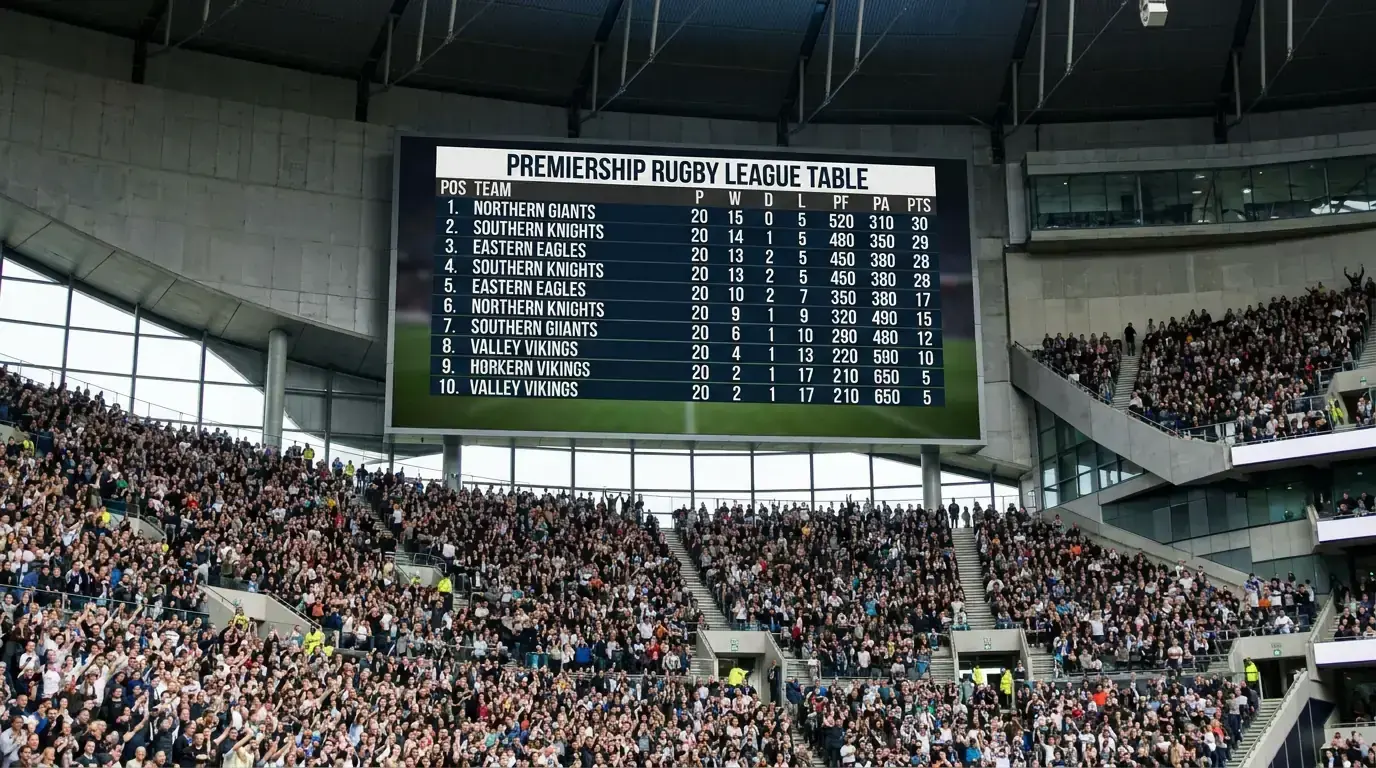
February through April is where the steepest price moves happen. The European Champions Cup pool and knockout windows pull squads in two directions, and clubs that prioritise the European competition often drop two or three Premiership matches in March and April. The teams that come through that window without dropping points become the play-off favourites, and the title price compresses around them. The final two regular-season rounds — typically late May — set the play-off bracket, and the four qualifying sides then carry day-of-event pricing into the semi-finals.
Home Advantage and Where It Lives
Home advantage in the Premiership averages around 7 to 9 points per match across the season, but the distribution isn’t uniform. Specific home grounds carry significantly more advantage than that average suggests, and others underperform it. Allianz Stadium has been one of the harder away trips in English rugby for several seasons; the Recreation Ground in Bath produces home wins above the league rate; the steep stands at Sandy Park give Exeter a meaningful edge against possession-heavy opponents. The list shifts year to year as clubs improve or decline, and the home-edge component of the handicap line should be calibrated to the specific ground, not the league average.
One pattern worth knowing. The opening fixture at any Premiership ground each season — the home opener — produces a measurably wider home edge than the same fixture later in the calendar. The reason is partly fan-energy at a sold-out ground after a summer break, partly the visiting side’s lack of recent match data on the home team’s new tactical setup. Pricing the home opener as a slightly stronger home edge than the headline line is one of the few persistent structural angles in Premiership match betting.

The European Pathway and What It Implies for Outright Bets
The Premiership feeds the top eight English clubs into European competition — typically the top seven into the Investec Champions Cup and the eighth into the Challenge Cup. The cross-tournament implication is that Premiership clubs in form often have to choose between league and Europe in March and April, and the choice they make is visible in their team selections. Clubs that target the European trophy rest first-team players in the league; clubs that target Premiership play-off qualification rest players in Europe. Knowing which way a club is leaning shifts the value of the Premiership outright against the European outright.

For the deeper pricing on Europe itself, the Investec Champions Cup betting guide covers the format, the cross-league matchups and the historical favourites in detail. The relevant point here is that the two competitions interact in ways that mean a Premiership-only outright view ignores half the calendar. The clubs in form for the title chase are often the same clubs deep in European knockout, and their team selections in the final six Premiership weekends reflect that dual focus.
