


Everything that actually matters happens
Rugby betting in the UK is the practice of placing real money on the outcomes of rugby union or rugby league fixtures through a UKGC-licensed operator. The market looks smaller than football or horse racing on raw volume, yet the average wager per active punter sits at the higher end of British sport — industry tracking puts rugby in a band with cricket, tennis, golf and boxing, where monthly stakes routinely clear £200 per punter. This is, in plain terms, a niche premium market.
I have spent a decade reading these markets, and one rule has only become clearer: the punters who last in rugby treat it as a numbers exercise first and a sporting allegiance second. The price beats the badge, every time.
£1.45bn
UK online gambling GGY in the first quarter of 2025, up 7% year on year
18%
of British rugby fans placed an online sports bet in the previous twelve months
70%+
of UK online sports betting now runs in play, up from under 30% a decade ago
This guide is built for the UK reader who wants the mathematics, the regulation and the calendar to make sense before placing a single bet in the 2026 season. The figures here come from primary sources — Gambling Commission quarterly returns, the International Betting Integrity Association's annual report, World Rugby and RFU regulations. I'll cover both codes, the six markets that cover most slips, the calendar from Six Nations through to the autumn internationals, the regulatory layer that has thickened since the January 2025 reforms, and the strategy mindset that survives a full season.
What I am not bringing is a league table of bookmakers, a top-five list, or any ranking that pretends to know which UKGC-licensed shop is best for you. That choice is binary — licensed or not. Everything that actually matters happens after the registration screen, and that is where this guide spends its time.
What This Guide Covers in 60 Seconds
- UK online gambling hit £1.45bn in Q1 2025 alone; sports betting is 57% of that pool, and rugby fans wager around £200 per active month.
- Two codes drive the calendar — union (Six Nations, Premiership, Champions Cup, RWC) and league (Super League). Each has distinct market patterns.
- Six markets cover most slips: Match Result, Handicap, Total Points, Try-Scorer, In-Play and Outright. In-play now runs over 70% of online sports volume.
- January 2025 reforms added a 0.1-1.1% statutory levy, £150 financial vulnerability checks and tighter slot stake limits on top of UKGC licensing.
- The integrity-aware mindset wins long-term: verify the licence, price the value against implied probability, fix your bankroll before kick-off.
The UK Sports Betting Market in Numbers
Open the Gambling Commission's quarterly return and the first figure that lands is the online gross gaming yield. £1.45bn for the first quarter of 2025, up 7% year on year. That is one quarter. My entire decade in this market started before some of the operators on that ledger had even applied for a UK licence. The British market did not just grow over those years; it consolidated and accelerated, and the sports betting line went with it.
The headline that matters for sport-focused punters is share. Sports betting now accounts for 57.1% of the UK online gambling market, ahead of slots and casino combined. The macro forecast tightens the picture — the UK sports betting market sat at $11.2bn in 2024 and is projected to reach $21.3bn by 2030, a compound annual growth rate of 11.4%.
Frequency matters as much as headline size. The Commission's operator data shows 290 million bets placed monthly on real events in the UK in 2025, across roughly 13.5 million average active online accounts — itself up about 2% on the previous year. The active core wagers far harder than the mean.

£1.45bn
UK online gambling GGY in Q1 2025
57.1%
share of UK online gambling that is sports betting
290m
online bets placed monthly on real events
13.5m
average monthly active online accounts
Two layers complete the picture. The first is the total gross gaming yield Britain reached at the end of 2024 — £15.6bn, the highest figure the regulator has ever published. Andrew Rhodes, who heads the Gambling Commission, was unambiguous at his ICE 2025 Barcelona keynote: gambling in Great Britain had reached the highest GGY ever seen at £15.6bn, and the official statistics, in his words, would tell anyone plenty about what was happening with gambling in the country. That record is not a one-off; it is the trend line.
The second layer is the shadow side. While the licensed market grew, an unlicensed parallel market grew faster.
£16.6bn
UK illegal-market gambling turnover in 2025, up from roughly £5bn in 2019. Yield Sec puts the illegal share at 9% of UK online gambling in the first half of 2025, against 0.43% in 2020 — a twentyfold increase in five years.
For rugby specifically, the figure you should hold in mind is not £15.6bn or £1.45bn. It is the share rugby actually commands inside that pool, and that number tells a very different story.
How Big a Slice Rugby Actually Takes
Here is the figure that surprised me most when I first saw it, and still does. YouGov's panel work asked British sports fans whether they had placed an online sports bet in the previous twelve months. Horse racing fans came in at 49%. Football fans at 23%. Cricket at 21%. Tennis at 16%. Rugby fans — the people who fill Twickenham, Murrayfield and the Principality on a Saturday — landed at 18%. That is a niche audience by any honest reading of the data.
| Sport | Share of fans betting | Punter profile |
|---|---|---|
| Horse racing | 49% | High frequency, broad mass-market base |
| Football | 23% | Highest absolute volume, lowest per-slip stakes |
| Cricket | 21% | Premium per-punter band, £200+ monthly |
| Rugby | 18% | Premium per-punter band, £200+ monthly |
| Tennis | 16% | Premium per-punter band, £200+ monthly |

That 18% is the figure every operator-side analyst grapples with when deciding how many rugby markets to publish and how much to commit to in-play pricing. Rugby cannot compete with football for sheer volume of slips. What it can do — and what industry tracking confirms — is generate per-punter stakes alongside cricket, tennis, golf and boxing in the premium band, where monthly wagers comfortably clear £200 per active customer. That is roughly eight to ten times the typical low-frequency football punter's monthly stake.
Three things drive that gap. The rugby calendar is concentrated — intense blocks around Six Nations weekends, autumn internationals, Champions Cup knockouts and Lions tours, separated by long stretches the casual fan ignores. The active rugby punter waits, then wagers heavily during the marquee weeks. The fan base skews older, higher-income and more analytically minded than football's, placing considered slips on fixtures it has watched two or three previous editions of. And rugby's market depth supports larger stakes per slip — handicaps in particular absorb four-figure stakes without distorting the price.
This is why I describe the UK rugby market as nichely premium. For the punter willing to put in the homework, the depth-to-competition ratio is favourable. There are fewer sharp eyes on a Saturday URC match than on a Tuesday-night Championship football fixture, and that is where the value tends to live.
Union and League Are Different Games, and Different Markets
The first conversation I ever had with a punter who was losing money on rugby went like this. Him: "I'm getting hammered on try-scorer markets." Me: "Which code?" Him: "Both. Either. What's the difference?" That conversation is most of the answer to most of his slips.
Rugby in Britain is two sports sharing a name. Union plays fifteen-a-side; league plays thirteen-a-side. Union has lineouts, scrums, rucks and mauls; league has the play-the-ball, six tackles per possession, and a much faster transition pattern. Match length, scoring economy, the role of the kicker, the structure of the season — all of it diverges once you go past the oval ball.
Try — the primary scoring play in rugby, awarded when an attacking player grounds the ball over the opposition's try line. Worth 5 points in union, 4 in league.
Conversion — a kick at goal taken after a try is scored, attempted from a line perpendicular to where the try was grounded. Success adds 2 points.
Play-the-ball — the league-specific restart after a tackle, in which the tackled player rolls the ball backwards with their foot before play resumes.
For the bettor, three differences matter. Scoring frequency comes first — league produces more tries per match on average, and tries are weighted differently in the scoring economy. A Super League fixture might see 8-10 tries; a Six Nations Test more commonly settles at 4-6 tries, with penalty goals carrying significant weight. A "5+ tries" market on an England-France clash is a different bet from the same nominal market on a Saint Helens-Wigan derby.
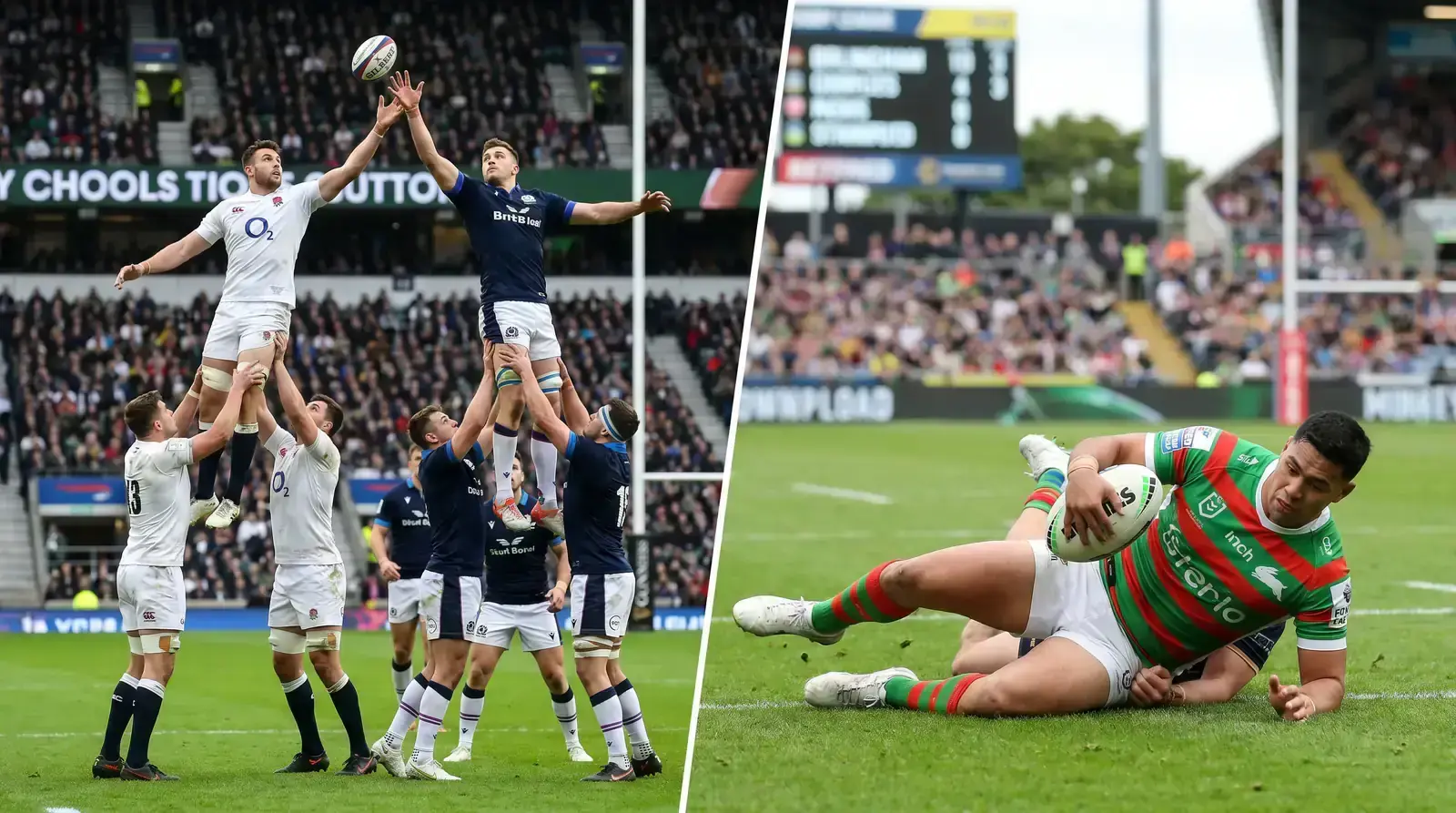
Markets themselves cluster differently. Try-scorer markets track tighter in league because the same handful of fullbacks, wingers and centres convert most of the available opportunities. In union, set-piece dominance matters more, and "first try" can be a back-row forward stealing a maul as often as a winger finishing wide. Handicap lines run wider in international union because Six Nations and autumn-international fixtures regularly produce 20+ point spreads between top-tier and second-tier teams; league handicaps are typically narrower because Super League's competitive distribution is flatter.
The season pattern diverges too. Union runs the European club season September to June, with internationals concentrated in February-March (Six Nations) and November. League runs Super League February to October, with the State of Origin series and the international window late in the year. A punter who tracks both codes is rarely without a fixture worth analysing.
| Element | Rugby Union | Rugby League |
|---|---|---|
| Players per side | 15 | 13 |
| Set-piece restart | Lineout and scrum | Play-the-ball after tackle |
| Possession structure | Unlimited phases until turnover | Six tackles per set, then handover |
| Try value | 5 points | 4 points |
| Typical tries per match | 4-6 in internationals | 8-10 in Super League |
| UK marquee competitions | Six Nations, Premiership, Champions Cup | Super League, State of Origin window |
| Dominant market shape | Wider handicaps, set-piece focused | Tighter handicaps, try-scorer heavy |
For a fixture-by-fixture breakdown of how the two codes diverge in actual betting markets, my cluster companion on rugby union vs rugby league betting takes the analysis deeper. The takeaway is simpler: a punter who treats the two codes as the same sport will misprice try-scorer markets, miss handicap value, and burn bankroll faster than the calendar can refresh it.
The Six Markets That Cover Most of My Rugby Slips
In my second season tracking these markets seriously, I tried to count how many distinct rugby markets a major UK operator publishes for a single Six Nations fixture. I stopped at 150 and the page was still scrolling. That breadth is real, but it is also misleading. Six market types cover well over 80% of the volume on any given match, and once you have those six in your head everything else is a variant or a derivative.

Handicap — a market in which the bookmaker adds or subtracts points from the final score to even out the perceived gap between teams; the punter bets on which side covers the adjusted line.
In-play — live betting placed while the match is in progress; prices update continuously as possession, momentum and score change.
Match Result
Two-way or three-way (Home, Away, Draw) on the 80-minute outcome. The simplest market, and the one most punters start with. Margins are generally tightest here because every operator prices within a narrow band.
Handicap
The points-spread market. A favourite gives points, an underdog receives points. In Six Nations fixtures handicap lines routinely sit at 10-20 points and sometimes wider. Half-point lines remove the push outcome; whole-number lines can settle as a stake-back push.
Total Points
Over/Under on the combined match total. Reads differently in union (lower totals, kicking-heavy economy) versus league (higher tries, faster scoring). Always check the operator's rounding convention before you place.
Try-Scorer
First, Anytime, Last, or 2-or-More tries by a named player. Extremely sensitive to team selection — a backline reshuffle the day before a fixture is the single biggest mover on these prices in my experience.
In-Play
Live pricing throughout the match. Now the dominant format on UK operators, accounting for over 70% of online sports betting volume against under 30% a decade ago. Liquidity peaks around significant events such as tries, yellow cards and substitutions.
Outright
Tournament winner, group winner, top try-scorer for a competition, Grand Slam, Triple Crown. Ante-post markets typically open weeks in advance and shorten as form clarifies. The best value tends to sit early when teams have most uncertainty priced in.
Each market deserves more depth than a card-grid tile, and the dedicated cluster piece — full rugby betting markets explained — walks through each with worked examples and settlement nuances. The principle to take from this overview is that every one of these markets prices a different question. Match Result asks who wins; Handicap asks who covers; Totals asks how the scoring economy is behaving; Try-Scorer asks who finishes the opportunities; In-Play asks what is changing right now; Outright asks how the tournament shape develops over weeks. A punter who knows which question is most reliably answerable for a given fixture — and concentrates slips there — is well on the way to value.
Fractional Odds, Decimal Conversions and the Bookmaker's Margin
The first ticket I ever wrote that paid out came back to a fractional bet I half-understood. £10 at 11/4 on a Six Nations away win in Cardiff. The slip cleared £37.50 and I had to look up what "11/4" actually meant before I cashed it. Most UK punters quietly admit the same thing. Fractional odds were never really taught here; they were absorbed.
UK bookmakers still default to fractional odds and probably always will, even though decimal odds are easier to work with and implied probability is what actually matters. Three formats — fractional, decimal, implied probability — describe the same number in different languages.
Fractional odds work like this. "11/4" means for every 4 units staked, the punter receives 11 units in profit if the bet wins. Stake £10 at 11/4 and the return is £10 (stake returned) plus £27.50 (profit), giving £37.50 total.
Decimal odds skip a step. 11/4 in decimal is 3.75. Multiply the stake by the decimal odds and the answer is the total return, stake included.

Implied probability is where the work actually happens. 11/4 corresponds to roughly 26.7% — the calculation is one divided by the decimal odds. What the bookmaker is saying with that price is "we think this outcome happens about 26.7% of the time." The punter's job is to decide whether the true probability is higher than that. If yes, the price has value. If no, it doesn't, no matter how attractive the return looks on the slip.
Worked example: £10 at 11/4
Fractional return: £10 + (£10 × 11/4) = £10 + £27.50 = £37.50
Decimal equivalent: (11 + 4) divided by 4 = 3.75. Return: £10 × 3.75 = £37.50
Implied probability: 1 divided by 3.75 = 26.7%
Value test: do you estimate this side wins more than 26.7% of the time? If yes, the price has edge. If no, it doesn't.
There is one more figure worth understanding before any slip goes down — the bookmaker's margin, also called the overround. Add the implied probabilities of every possible outcome of a market and the total will exceed 100%. That excess is the operator's edge built into the prices. On a tight Six Nations decider, a sharp UK book might run a margin around 3-5%; on an obscure URC fixture with low liquidity, that margin can easily double. Take a Six Nations outright market with all six teams priced — sum the implied probabilities of each individual price and the total might come to 112%. That 12% is the operator's overround on the outright market. Across a season of slips the overround is the single largest mathematical force working against the punter. It can be modelled, it can be priced in, but it cannot be ignored.
The Rugby Calendar a UK Punter Plans Around
The 2025 Men's Six Nations attendance numbered 1,050,465 across fifteen matches — an average of 70,031 per fixture, with 108 tries scored across the championship. Numbers like those reframe what "major tournament" means in a UK rugby betting context. The Six Nations is not just popular; it is the structural anchor of the entire calendar.
For a UK punter, the rugby year breaks into four blocks that demand attention.
Guinness Six Nations
February through March. England, France, Ireland, Italy, Scotland, Wales. Fifteen matches across five weekends. The 2025 edition generated $135.24m in media revenue from the UK, French, Italian and Irish broadcast deals — the commercial spine of European rugby. Outright and Grand Slam markets open weeks in advance; round-by-round markets cover every fixture.
Gallagher Premiership
September through June. Ten clubs, 80 regular-season matches plus play-offs and final. The £200m five-year TNT Sports deal running to the end of 2030/31 puts every Gallagher Premiership match on a UK rights-holder. Match volume rises sharply through the knockout rounds and the showpiece fixtures at Tottenham Hotspur Stadium.
Investec Champions Cup
December through May. European club rugby's marquee competition. The 2025-26 edition pulled 1,059,748 attendance across the campaign with 519 tries scored; the Bilbao final alone drew 52,327. Knockout stages from April produce the deepest in-play liquidity outside Six Nations weekends.
British and Irish Lions Tour
Every four years. The 2025 tour to Australia brought roughly 40,000 travelling fans and set the Lions attendance record on Australian soil when Test 2 at the Melbourne Cricket Ground exceeded 90,000 spectators. Rugby Australia recorded an A$70.8m profit on the back of the tour. Outright series and individual Test markets dominate the betting volume.
Below those four sit two competitions I track but bet less heavily on. Super League runs February through October with deep try-scorer and handicap markets. The United Rugby Championship blends Irish, Welsh, Scottish, South African and Italian sides across a September-to-June season. Both have value windows, but liquidity is thinner and market depth more variable. The Rugby World Cup sits above everything else when it returns on its four-year cycle; the southern hemisphere Rugby Championship adds a late-summer fixture set worth tracking even from a UK desk.

What ties the calendar together is rhythm. There is no single month where I am pricing every available rugby fixture — but there is also no two-month stretch where there is nothing serious to look at. The disciplined approach is to allocate bankroll against the calendar in advance, not to chase whatever happens to be on Sky tonight.
The cluster article that takes the spring window apart fixture by fixture is my Six Nations betting guide. It treats each Six Nations weekend as its own pricing event with its own market mechanics.
Why In-Play Now Runs the UK Online Market
The 2025 Six Nations round between Ireland and France ran into the last two minutes with France two points ahead. A turnover at the Irish lineout shifted the in-play match-winner implied probability by more than 30 points in roughly fifteen seconds. That is live betting doing what it does — and it is also why in-play has come to run the entire UK online sports book.
In-play now accounts for more than 70% of UK online sports betting volume, against under 30% a decade ago. Rugby is particularly well suited to live betting because its rhythm of possession, set pieces and frequent stoppages gives the market natural reset points to update prices and post new markets. Live betting represents a considerable share of overall rugby wagering, with market values adjusting quickly in response to possession changes, injuries and substitutions.

The three biggest in-play movers in a rugby match
A yellow or red card that changes the player count for 10 minutes or the remainder. An injury to a kicker or fly-half forcing a positional reshuffle. A turnover or breakdown penalty inside the 22-metre line in the final ten minutes. Each one can shift the match-winner implied probability by 15-30 points within seconds.
What in-play asks of the punter that pre-match betting does not is decision speed. The prices reset every few seconds. A bet builder attractive at one set of pre-match prices may be entirely different in implied probability by half-time. This is what catches most newcomers to live rugby betting — they bring a pre-match mindset to a market that has already moved several times since they last refreshed the page.
The other thing in-play demands is liquidity awareness. The deepest in-play rugby markets sit on Six Nations matches, Premiership knockout rounds, Champions Cup quarter-finals onwards, Lions Tests and the showpiece RWC fixtures. On a midweek club friendly or a lower-tier URC fixture, the in-play markets thin out fast — fewer markets, wider margins, slower price updates. Knowing where the deep liquidity lives is knowing where the in-play edge can actually live.
The Regulatory Layer Every UK Rugby Punter Sits Inside
On 17 January 2025 the cost of a single online slot spin in the UK was capped at £5 for adults and £2 for the 18-24 cohort. That was one of seven distinct regulatory actions taken in the space of a year. If you stopped paying close attention to UK gambling policy around 2022, the rulebook you remember is not the one in force in 2026.
The UK's regulatory architecture for online sports betting is built on the 2005 Gambling Act and operated through the UK Gambling Commission. Every legal operator offering rugby markets to UK residents holds a UKGC licence; without it, the operator is by definition illegal here. That binary is the first filter, and it has been the same for two decades. What has changed dramatically is everything that sits on top of that licence.

Key UK gambling reforms in force for 2026
Statutory levy on operators, introduced April 2025 at 0.1%-1.1% of operator GGY. Expected to raise roughly £100m a year for research, prevention and treatment of gambling harm.
Financial Vulnerability Checks. Launched 30 August 2024 at a £500 net-deposit threshold over 30 days; lowered to £150 from 28 February 2025. The Commission's modelling indicates around 3% of accounts would be affected.
Slot stake limits. From 17 January 2025, £5 per spin for adults 25 and over, £2 per spin for 18-24-year-olds.
Spin speed and game format. From January 2025, a minimum 5-second spin on casino games, with autoplay and simultaneous game-play banned.
Premier League front-of-shirt gambling sponsorship. Voluntary ban from the end of the 2025-26 season. In 2024-25, 11 of 20 clubs carried a gambling brand front-of-shirt.
For sports betting specifically, the most consequential change is the Financial Vulnerability Check. It applies above a £150 net-deposit threshold over 30 days, which is a level most active rugby punters will cross during any Six Nations round. The check is designed to be frictionless — using publicly available financial data the operator already has access to — and the Commission's own modelling suggests only a tiny fraction of accounts will need anything beyond that. The wider statutory levy, scaled to operator GGY at 0.1%-1.1%, funds roughly £100m a year of harm-reduction work.
What this means for a rugby punter in practice is straightforward. The UKGC-licensed shop you place a slip with in 2026 is more tightly regulated, more proactive on customer protection, and more accountable than at any point in the British market's history. The full deep treatment of how this regulatory layer interacts with rugby specifically sits in my UK rugby betting regulation explained cluster piece.
The Illegal Market Knocking on the Door
Yield Sec's tracking puts the UK illegal online gambling market at 9% of total online gambling in the first half of 2025. In 2020 that same metric was 0.43% — a roughly twentyfold increase in five years. Grainne Hurst, who runs the Betting and Gaming Council, has called it what it is: a harmful black market scaling up at pace, with illegal operators becoming more sophisticated, more visible and more aggressive in how they reach UK customers.
The numbers behind that judgement are worth pausing on. UK illegal-market turnover went from roughly £5bn in 2019 to £16.6bn in 2025 — a tripling in six years, a doubling between 2023 and 2025 alone. The licensed market's share of total UK gambling fell from 97% in 2019 to 92% in 2025. The most aggressive single channel is the "not on GamStop" segment, which Yield Sec analysis indicates carries roughly 84% of illegal promotional activity in the UK, targeting self-excluded players and minors as its primary audience. Yield Sec president Ismail Vali has put it precisely: illegal online gambling in Britain is, by his estimate, knocking on 10% market share, and it has reached that share through cynical exploitation of two vulnerable audiences — children and self-excluded gamblers on the GamStop scheme.

For a rugby punter the practical question is recognition. How do you tell a UKGC-licensed operator from an illegal one when you land on a site that looks polished and offers rugby markets?
Five flags that tell you a rugby betting site is not UKGC-licensed
The footer does not display a Gambling Commission licence number with a working link to the Commission's public register.
The site advertises itself as "not on GamStop" or markets explicitly to self-excluded customers.
Promotional terms do not reference the Commission's current advertising rules or UK responsible-play language; the wording reads as if translated from a non-UK template.
The site accepts cryptocurrency deposits with no integrated British banking route. The UKGC framework treats crypto-betting with deliberate friction; a frictionless crypto-only flow is a red flag.
There is no clear UK customer support route — no UK phone number, no UK postal address for complaints, no mention of the Independent Betting Adjudication Service for dispute resolution.
If any of those flags appear, walk away — and report the operator to the Commission. UKGC took 770 cease-and-desist actions, removed 264 sites and submitted 102,000 URLs to Google for delisting across 2024-2025, with 64,000 already removed at last count. The system works, but only when punters help it work. The bookmaker margin you might save on an unlicensed slip is dwarfed by the protections you shed — settlement disputes you cannot escalate, integrity feeds you are outside, identity and bank data sitting with an operator that has no UK regulatory accountability.
How the Integrity Net Around Rugby Is Stitched Together
World Rugby Regulation 6, the anti-corruption code that governs betting on the sport at international level, opens with a line that should be framed on the wall of every operator running rugby markets. Public confidence in the authenticity and integrity of the sporting contest is, the regulation says, of paramount importance — and if that confidence were to be undermined, the game would be fundamentally affected. The text acknowledges that technology, popularity, television and the expansion of betting markets have led to a significant increase in the amount and types of bets being placed on rugby.
Three institutions, working together, hold the integrity perimeter around UK rugby betting. The UK Gambling Commission's Sports Betting Intelligence Unit monitors suspicious betting patterns across the licensed UK market and shares intelligence with regulated operators and governing bodies. The International Betting Integrity Association (IBIA) operates a global monitoring platform watching betting activity across more than 1.5 million matches in over 80 sports, covering more than $300bn in annual wagering. In 2025 IBIA issued 300 suspicious-betting alerts, up 29% from 232 in 2024, and participated in sanctions for 54 proven match-fixing cases. The increase reflects expanding monitoring reach as much as a rising baseline of integrity risk — a distinction worth holding onto when the headlines arrive.
The third layer is sport-specific. RFU Regulation 17, in force since 1 August 2025, applies to international players and contracted club players, prohibiting them from betting on rugby; World Rugby Regulation 6 covers the international tier with the same prohibitions and penalties up to lifetime bans. In April 2026 Oval — the only data provider focused exclusively on rugby — joined IBIA as an Associate Member, deepening the rugby-specific data feed available to the integrity network.
Why integrity matters to the punter
Every IBIA alert generated on a rugby market is information available to regulated UK operators in close to real time. A fixture under integrity review can have markets suspended, lines adjusted, or settled differently than would otherwise have been the case. Betting through a UKGC-licensed operator means betting inside that feedback loop. Betting through an illegal channel means betting outside it entirely.
The Strategy Mindset That Survives a Full Season
At the 2023 Rugby World Cup, the favourites won at rates almost identical to what the stat models forecast — not what crowd intuition or the bookmakers' posted odds suggested. The average prediction error stayed below 6 points per game across 48 matches, a lower error rate than the published lines tended to produce. The numbers, in other words, beat the narrative.
Strategy in rugby betting is not a sentence. It is a workflow. I'll keep the philosophy here brief, because the full rugby betting strategy fundamentals are covered in the dedicated cluster piece, but five principles run through everything I do.
Value first, outcome second. The job is not to pick winners; it is to pick prices that are mispriced relative to true probability. A losing slip on a positive-EV price is a better decision than a winning slip on a negative-EV one. Over a season, the maths converges to decision quality, not result quality.
Fixed bankroll. The pool allocated to rugby for the season is set before the season begins. It is not topped up mid-stride or extended for "one last bet" on the autumn-international finale. A unit size — typically 1-3% of the season bankroll per slip — is set and adhered to. This is the single most consistent dividing line between punters who survive multi-season swings and those who do not.
Do not bet the team you support. If you cannot price your own side dispassionately, do not put money on them at all. The bookmaker's price already reflects national sentiment, and that distortion is where most casual money sits.
Know your edge by market type. Try-scorer markets reward team-news watchers. Handicap markets reward those who track scoring margins over a season. Outright markets reward early movers in ante-post. Concentrate volume where you do the analytical work well.

Treat every slip as an integrity-aware bet. Bet only through UKGC-licensed operators, on fixtures inside the regulated integrity perimeter. The illegal market may offer fractionally better margins, but the price saved on the line is lost on the protection that is not there.
Six checks before every rugby slip
- Verify the operator's UKGC licence is current and the footer link works.
- Confirm market depth on the fixture — at least three operators publishing tight prices indicates real liquidity.
- Check the most recent team-news cycle, particularly for try-scorer and handicap markets.
- Calculate the implied probability of the price and compare it to your own probability estimate.
- Confirm the stake fits your bankroll unit size before clicking through.
- Set the loss limit and session time-out for the betting window if you have not already.
Interactive tool
Bankroll & unit-stake planner
Fix your season pool, pick a unit size, and see your stake per slip — plus how long a losing run your bankroll actually survives. Bankroll discipline is what keeps an edge compounding instead of collapsing.
Unit size vs the recommended band
- Stake per slip £10.00
- Profit if it wins £15.00
- Break-even win rate at these odds 40.0%
- Losing slips in a row to your stop 12
The Tools the UK Already Gives You for Free
The single most useful figure in any conversation about responsible play in the UK is 21.9%. That is the proportion of adults aged 18-24 who score 1-27 on the Problem Gambling Severity Index — the highest of any age band. 5.3% of that same group score in the top category. The British government did not introduce £2-per-spin slot limits for the 18-24 cohort in January 2025 because it wanted to. The data told it to.
Responsible play in the UK is a system, not a slogan. The architecture is built into every UKGC-licensed operator and the punter who knows where the levers are has more control than the one who does not.

The UK responsible-play toolkit, free at the point of use
GamStop. The national self-exclusion scheme. One registration excludes the punter from every UKGC-licensed operator for 6 months, 1 year or 5 years.
BeGambleAware. The independent harm-reduction charity, supported by industry funding. National helpline, online resources, and regional treatment referral pathways.
Operator-level limits. Deposit limits, loss limits, single-bet limits, session time limits, reality checks. Set inside the account and enforced automatically, with a cooling-off period before they can be relaxed.
Financial Vulnerability Checks. Trigger above £150 net deposits over 30 days. Designed to be frictionless for the vast majority of accounts.
NHS Gambling Clinics. NHS-funded specialist treatment services for problem gambling, available across England, Wales, Scotland and Northern Ireland.
On the funding side, the Betting and Gaming Council and its members voluntarily contributed over £170m across the four years to 2024, financing an independent network of charities that currently cares for roughly 85% of all problem gamblers receiving treatment in Britain. The statutory levy introduced in April 2025 sits on top of that voluntary contribution rather than replacing it.
Responsible play is the operational floor of the regulated UK market. A punter who treats the tools as default settings rather than emergency brakes will get more out of the experience and protect against the worst of the downside. The most disciplined punters I know set their deposit limits on day one of a season, not on the day they regret their last slip.
Common Questions UK Rugby Punters Ask Me
Is online rugby betting legal in the UK?
Yes, provided the operator holds a current UKGC licence and the punter is 18 or older. Every legal rugby betting site in the UK is licensed and regulated by the Gambling Commission under the 2005 Gambling Act and its subsequent amendments. The simplest verification is the licence number displayed in the operator's footer with a working link to the Commission's public register. If that is missing — or if a site explicitly markets itself as "not on GamStop" — it is operating outside the legal framework and should be treated accordingly.
What are the main types of rugby bets?
What's the difference between rugby union and rugby league betting?
How do rugby handicaps and point spreads work?
When is the Six Nations and how can I bet on it?
How do I bet responsibly on rugby?
What Stays With You After the Whistle
If I had to compress a decade of reading rugby markets into three lines, they would be these. Integrity first. Value next. Bankroll last. In that order, every time, regardless of who is favourite and regardless of how much the price has moved since the team news broke.
Integrity is the cheapest variable to verify and the most expensive one to ignore. The UKGC licence number in the operator footer, the IBIA alert feed running quietly in the background, World Rugby Regulation 6, RFU Regulation 17 — that perimeter is what makes a £15.6bn regulated market a regulated market. The illegal economy attached to it is bigger again, and it pays nothing into the £170m the licensed industry funds for research, education and treatment. Where you bet matters before what you bet.
Value is the work of the whole season. A coefficient is not a prediction; it is a statement about probability with a margin attached. The job is to form an independent view of that probability and bet only when the operator's view is meaningfully softer than yours. Most slips fail not because the rugby was unpredictable but because the punter did not check whether the number on offer was actually generous.
Bankroll is what protects you from being right too late. Set it before the season opens. Keep unit size between one and three percent of the pool, no matter how confident the next slip feels.
The three principles that survive any rugby season
- Integrity — verify the UKGC licence before the first stake, and treat every "not on GamStop" pitch as the boundary marker it is.
- Value — back the number, not the badge. A 11/4 price on a side you make 3/1 is a bet; the reverse is a donation.
- Bankroll — fix the season pool in advance, stake one to three percent per slip, and never chase a losing weekend with a bigger Sunday slip.
The next match on the calendar will not care about any of this. That is the point. The discipline is yours to bring, and it is the only edge a UK rugby punter truly owns.
