


The cash-out button changed the psychology of UK rugby betting more than any other product feature of the last decade. Before it existed, a pre-match stake was a sealed envelope — you opened it at the final whistle and saw what was inside. After it arrived, every running stake became a live position with a current market value, refreshing every few seconds, tempting you to lock in something rather than wait for the end. That temptation is the entire commercial point of the feature, and understanding when to resist it is more valuable than understanding when to use it.
Cash-out is the option to settle a stake before the final whistle at a value the bookmaker quotes you. The mechanic is simple: the operator calculates the current implied probability of your bet winning, applies a margin, and offers you the resulting value as an immediate settlement. Take it and you walk away with that value, win or lose at the final whistle. Refuse it and the original stake runs to completion. The decision feels small in any individual instance and adds up to a meaningful part of your annual P&L if you make it badly often enough.
How the Cash-Out Number Is Built
The cash-out value isn’t magic; it’s a calculation. The bookmaker’s live pricing engine produces a current implied probability that your bet will win based on the in-play state of the match. For a pre-match handicap on England at −10 with England leading by 7 in the second half, the implied probability of England covering might sit around 65 per cent. The fair cash-out value of a £10 stake at evens would therefore be £13.00 — the £10 stake plus £3 of expected profit derived from the 65 per cent probability.

The bookmaker then applies a margin. The cash-out you actually see on screen will be lower than £13.00 — typically between £11.50 and £12.50, depending on the operator’s house margin. That 3 to 8 per cent shave is the price you pay for the certainty. Take the cash-out and you walk away with the discounted value; let it ride and you keep the full expected value of your original stake but accept the variance.
The numbers update with every match event. A try, a card, a missed penalty kick, even a long phase of possession all reprice the implied probability and therefore the cash-out value. The button on your screen is a moving target, and the operator’s offer can shift by 20 per cent or more in the space of thirty seconds when the match is in a volatile state. The pricing engine is responding to the same live signals as the in-play handicap market — possession changes, injuries, substitutions, and any tactical shift that moves the implied probability of your bet’s outcome.
Partial Cash-Out: The Underrated Middle Path
Partial cash-out lets you take a slice of the current value and leave the rest exposed. Cash out half the position and you collect 50 per cent of the current offer; the remaining 50 per cent runs to settlement on the original stake terms. The mechanic is at most major UK operators on most rugby markets, though some niche markets and some multi-leg bet builders don’t support partial.
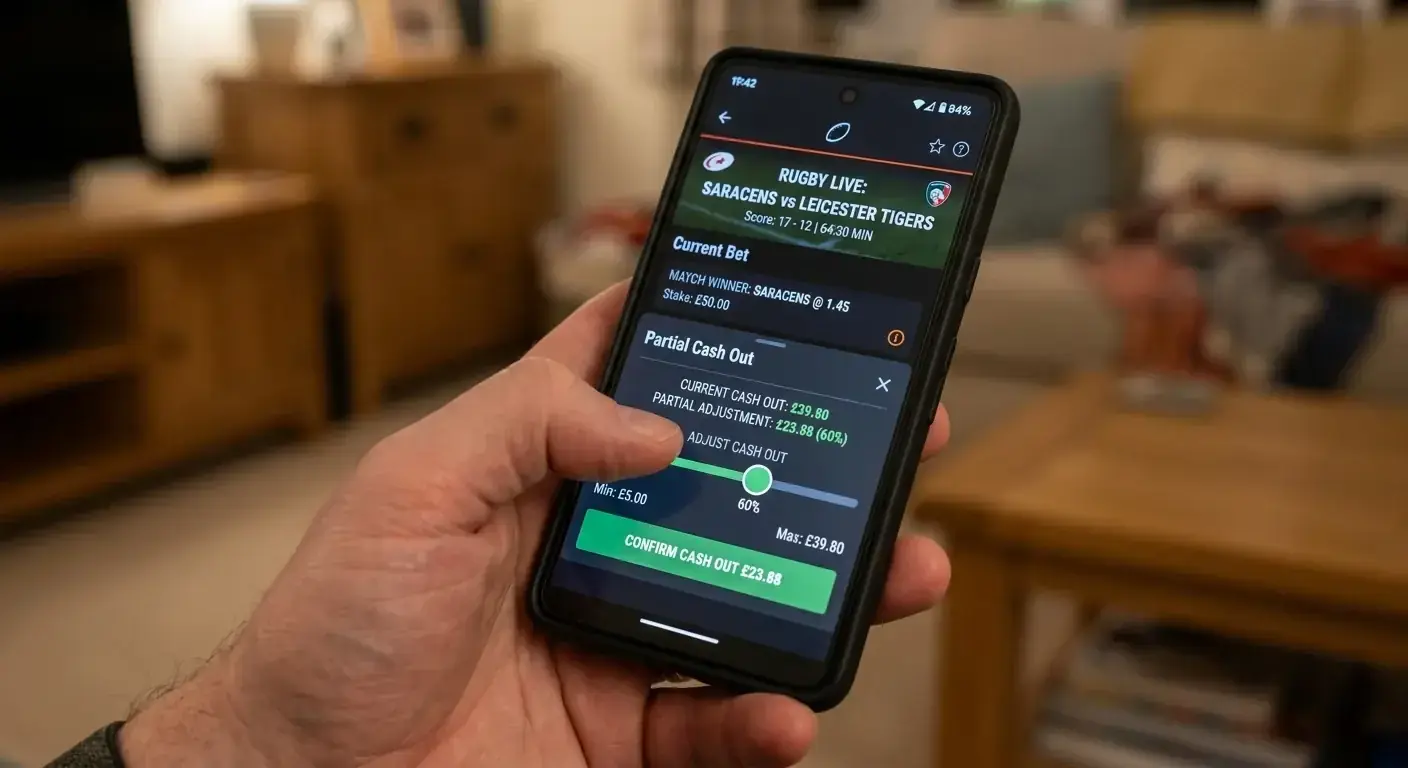
The use case I rely on most is half-time positioning. A pre-match handicap that’s run sweetly through the first forty minutes might have a cash-out value 30 per cent above stake at the break. Partial cash-out at 40 to 50 per cent of the position locks in that gain and lets the rest of the bet run on the assumption that the second half will continue in the same direction. If it doesn’t — if the trailing side comes back — I’ve still banked the half-time slice. If it does — if the favourite pulls further away — the remaining half settles at full value.
The trade-off is that partial cash-out compounds the margin shave. A 5 per cent margin on full cash-out becomes effectively 5 per cent on the cashed portion, with zero margin on the running portion. That’s a smaller drag than a full cash-out, but it’s also a smaller insurance. The choice between partial and full is really a question of how much certainty you’re buying versus how much exposure you’re keeping.
Auto Cash-Out: Setting a Trigger and Walking Away
Auto cash-out is the pre-set instruction that closes your bet automatically once the cash-out value hits a threshold you specify. Set the trigger to £25 on a £10 stake and the operator settles the bet the moment the cash-out value reaches £25 — no matter what’s happening on the pitch. The feature is genuinely useful for unstable matches, and it changes the way you can stake when you know you won’t be watching live.
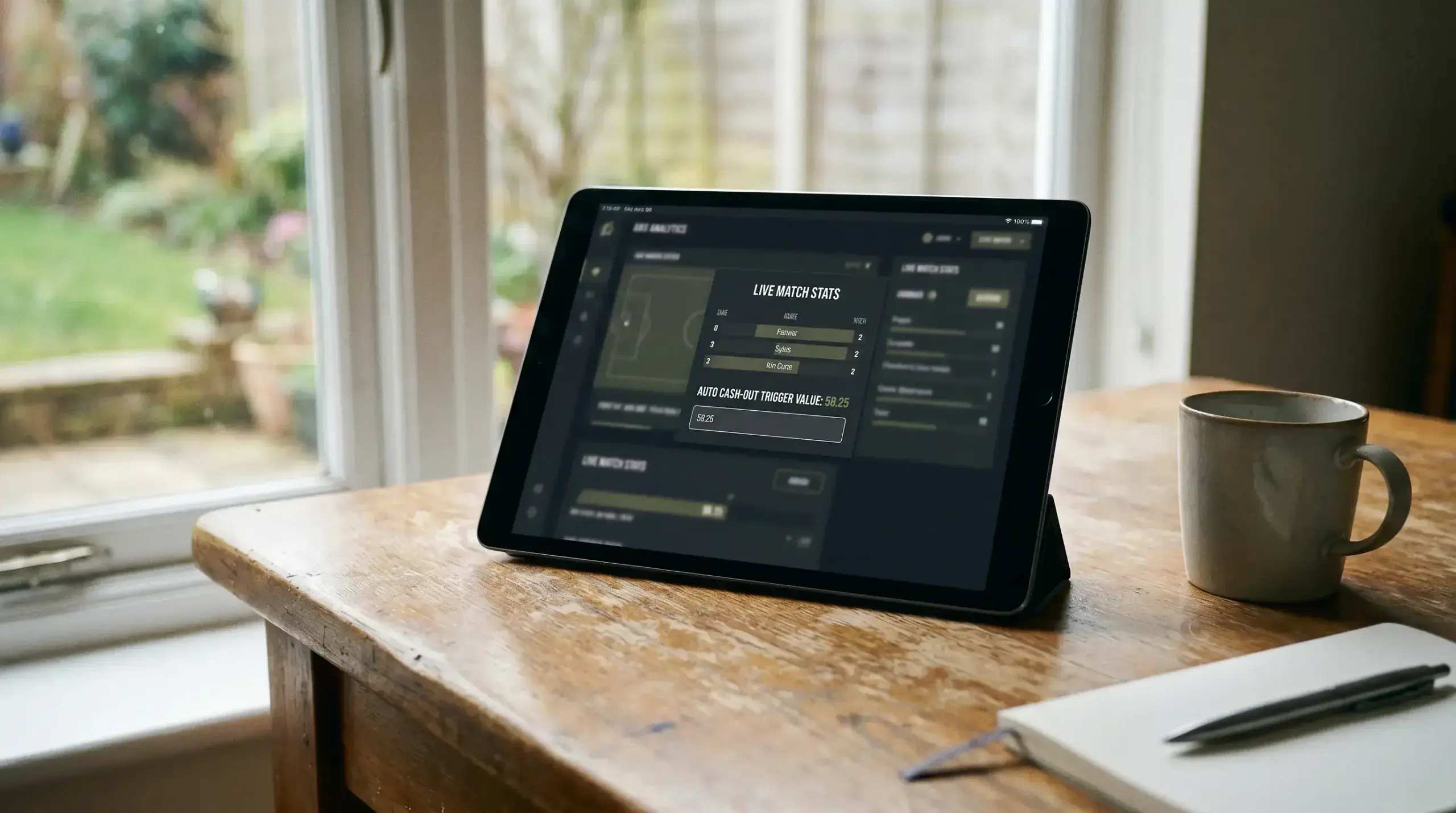
Italy fixtures during the Six Nations are the archetype. Italy have improved structurally over the last few years, but their match flows still produce more volatility per minute than any other Six Nations side. A 4-try first half is followed by a yellow-card-driven collapse; a comfortable lead at half-time is followed by a second-half meltdown. Setting an auto cash-out on Italy or against-Italy stakes is a way to bank gains without trusting yourself to act at the right moment during a wild thirty-minute stretch.
The downside of auto cash-out is the trigger value can be reached and surpassed in the same volatile patch. If your trigger is £25 and the cash-out value spikes to £40 in the heat of a key try, the auto-cash banks the £25 and you miss the £40. Some operators offer trailing triggers — the cash-out activates only if the value drops back from a previous high — and these are mechanically smarter, though they’re still subject to the bookmaker’s margin at the moment of execution.
When Cashing Out Is Actually a Good Idea
Cash-out is structurally a negative expected-value product. The bookmaker’s margin on the cash-out value is the operator’s profit; from your side, every cash-out you take is a small donation to the operator’s bottom line in exchange for certainty. Over hundreds of bets, the consistent cash-out user pays a meaningful percentage of their gross winnings back to the bookmaker for the convenience of locking in.
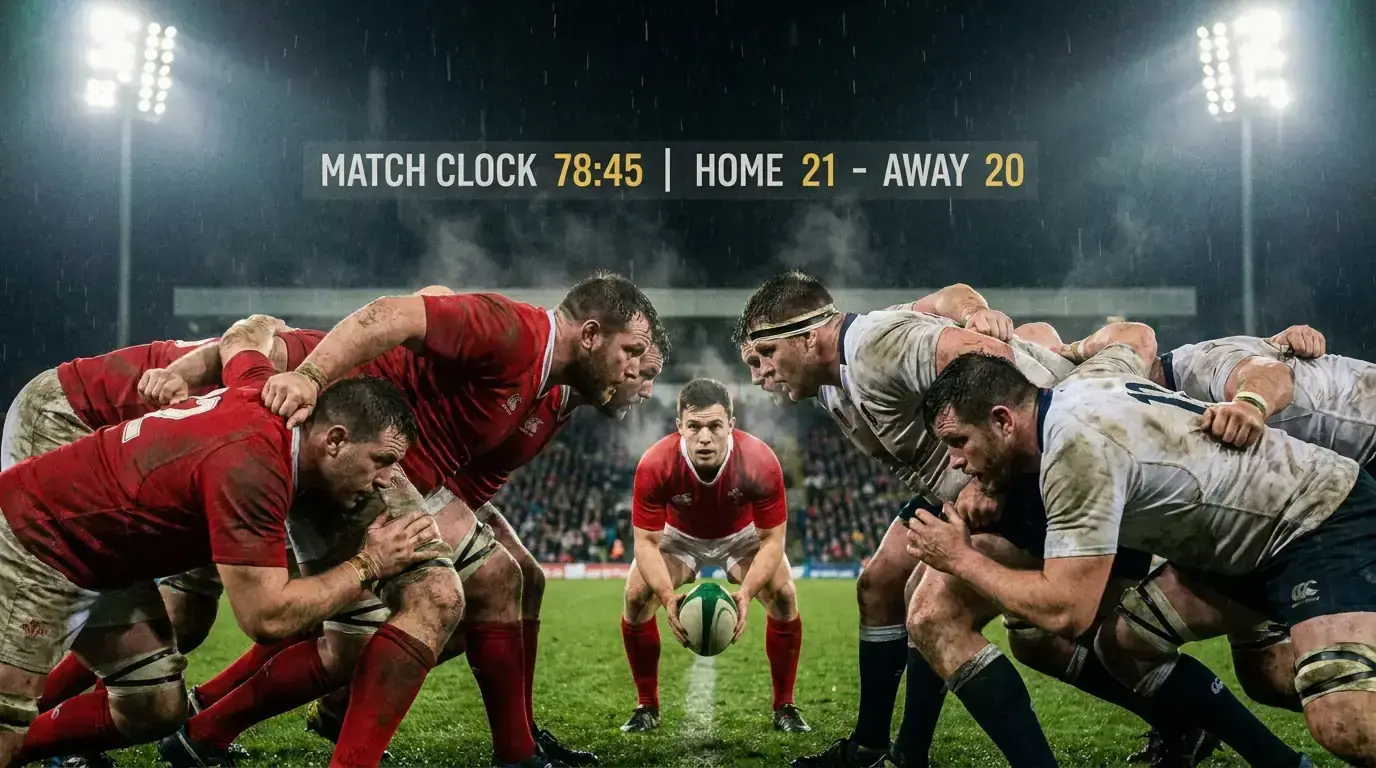
That said, there are specific situations where cash-out is the right call even at a negative EV. The first is bankroll preservation — if a single position’s running value would take your active bankroll above a threshold you’ve set for variance, cashing out part of it brings the exposure back inside your discipline. The second is information asymmetry — if you have a reason to believe the match is about to flip (a key player off injured, a yellow card pending) but the live market hasn’t caught up, cashing out at the pre-flip price is a positive EV move. The third is psychological — if you can’t watch a tight finish without risk of revenge betting, taking the cash and walking is worth the margin shave.
Outside those scenarios, the right answer is usually to let the stake run. The certainty premium the operator is charging is meaningful, and the 13.5 million active monthly online accounts in the UK include a large share of habitual cash-out users who are quietly leaking value with every click of the button.
Cash-Out and Live Betting as a Single Toolkit
Cash-out interacts with live betting in ways that change how you should think about both products. A pre-match stake combined with an in-play hedge can produce a position with negative downside and positive expected value if the entry prices are favourable. The mechanics of how live markets reprice and where the volatility tends to be sharpest are worth understanding alongside cash-out, and the full picture of in-play rugby betting mechanics is the natural companion read. In-play accounts for more than 70 per cent of UK online sports betting volume, and cash-out is the feature that ties pre-match and live products together.

The mental model that’s served me best: cash-out is an exit, not a strategy. You enter a position with a view; you exit either when the match ends or when your view is no longer correct. Cashing out for any other reason — because the button is there, because the value looks tempting, because you’re nervous about the last ten minutes — is the bookmaker harvesting your variance aversion at the going rate.
