


There are two sports called rugby and they share roots, a ball, and almost nothing else. I have been pricing both since 2015 — rugby union internationals, Gallagher Premiership, the United Rugby Championship, Super League, NRL, the Challenge Cup — and the lesson that has stayed sharpest across that decade is that the betting models for these codes are not interchangeable. The set of probabilities you build for an England-France Six Nations clash will steer you badly wrong if you take it into a Wigan-St Helens Super League fixture the following weekend.
Different number of players. Different scoring values. Different season calendars. Different broadcast economies. Different favourite-versus-underdog dynamics. Two sports, two betting books, two cultures of pricing.
This guide is for the bettor who knows one of the codes and is moving into the other, or who already bets both and wants a clearer view of where the markets and pricing systems diverge. I am writing neutral to both sports — I price union and league with the same respect because I trade them both — but the differences are real and worth setting out clearly. Cross-code mistakes are expensive when you are not prepared for them, and a Saturday lost to a model error you did not need to make is the worst kind of loss because it never had to happen.
Two Sports, One Bloodline
At a hotel meeting in Huddersfield on 29 August 1895, twenty-two clubs from the north of England broke away from the Rugby Football Union over the question of paying players for time lost from work. The Northern Union, later the Rugby Football League, was born that night. The Rugby Football Union, which had refused to allow broken-time payments, kept its game strictly amateur until 1995. A century of separate development between two codes started over a hotel-meeting argument about three shillings a match.
That history shapes the geography you see on a betting board today. Rugby union spread from Twickenham southward through Wales, Ireland, Scotland and France, jumped to the southern hemisphere — South Africa, New Zealand, Australia, Argentina — and built an international fixture list anchored on Six Nations, the Rugby Championship, autumn internationals and the Rugby World Cup. Rugby league concentrated in the north of England, crossed to Australia and New Zealand, became dominant in Queensland and New South Wales, and produced the Super League, the NRL and State of Origin as its three biggest betting properties.

Modern union competitions you will find on a UK book: Gallagher Premiership, United Rugby Championship, Top 14, European Champions Cup, Six Nations, autumn internationals, and the Rugby World Cup every four years. Modern league competitions: Super League, the Challenge Cup, NRL, State of Origin, and the Rugby League World Cup every four years.
The fixture timelines overlap in different ways, which matters for bankroll planning more than people give it credit for. Six Nations runs February-March; Super League is in mid-season at the same point. Premiership runs September-June with a winter break; NRL runs March-October. If you bet both codes seriously, you are working a calendar with very few quiet weekends. I will get to season-and-calendar mechanics specifically below — for now, just register that the two codes were never about to converge once that 1895 vote went against the union side.
Fifteen, Thirteen and Everything That Hangs on the Difference
Hand a rugby union scrum cap to a league forward at training and he will tell you that the most useful piece of kit is the one that fits closest to his head, because in his sport you do not contest the breakdown — you reset every six tackles whether the ball has gone backwards or forwards. Hand a league player’s training notes to a union flanker and he will not recognise three of the five sessions, because his work at the breakdown is half of what he is paid to do. Same ball. Different sports entirely.
Rugby union plays fifteen-a-side, two halves of forty minutes each, with a tackle contest at every ruck that can produce turnovers, penalties or held-up territory. Possession is not capped — a team can string fifteen, twenty, thirty phases off one piece of ball if its defence allows it. Set-pieces are scrums and lineouts, both genuinely contested. Scrums in particular are themselves a try-scoring platform — a dominant scrum can win penalties on a single phase that the attacking side then kicks for territory or goal.
Rugby league plays thirteen-a-side, two halves of forty minutes each, with the play-the-ball replacing the ruck. There is no contest for possession in open play — once the ball-carrier is tackled, he plays the ball backwards with his foot and a teammate scoops it up. The defending side loses control voluntarily after each tackle, but possession is capped at six tackles before it turns over to the opposition. Set-pieces are scrums (largely uncontested in modern league) and the goal-line dropout. Discipline is policed with sin bins and dismissals, and the rules-set is in general simpler than union’s.
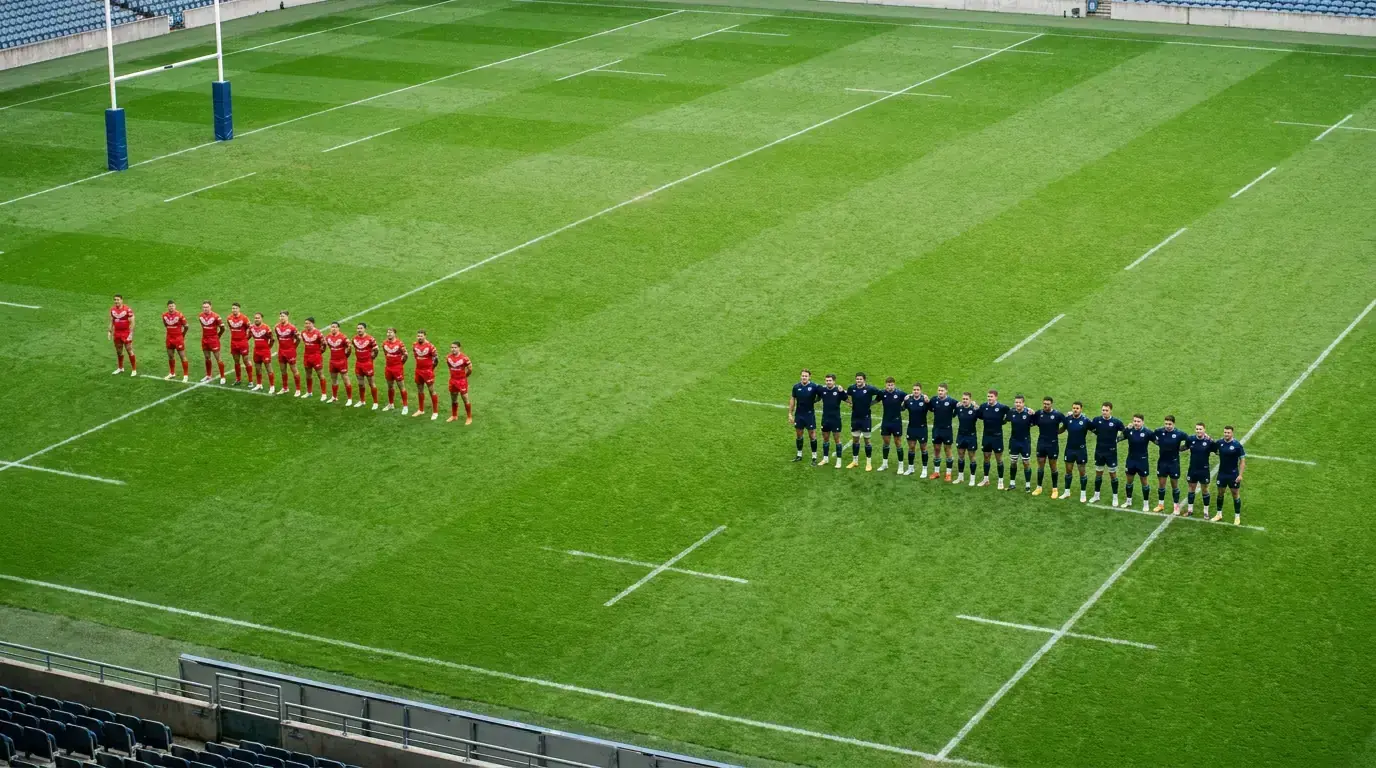
The betting consequences are direct. Union’s contested possession means dominant forward packs can stretch single periods of pressure into ten- and fifteen-minute scoring runs — handicap markets price wider as a result. League’s six-tackle structure caps that, so margins between sides who finish 30-12 in league look different on the spread to a similar union scoreline.
Yellow cards bite differently in the two codes. A ten-minute sin bin in union, with one team down to fourteen, reshapes the breakdown contest catastrophically. In league, with the team down to twelve, the six-tackle structure absorbs much of that shock. Win-probability swings are sharper in union than in league for an equivalent card, and the in-play market reflects that.
Different Maths on the Scoreboard
A try in rugby union is worth five points. A try in rugby league is worth four points. That one-point gap, multiplied across a match where each side might score four or five tries, accounts for most of the average-total spread between the two codes — and it is the first arithmetic that betting models for either sport have to internalise.
The full scoring table breaks down like this. Union: try five, conversion two, penalty three, drop goal three. League: try four, conversion two, penalty two, drop goal one. In 2026 the Super League is running a two-point field-goal trial from distance — a kicked drop goal beyond 40 metres pays two points, while shorter ones still pay one. That trial changes long-range late-game pricing decisions in league for the first time in decades.
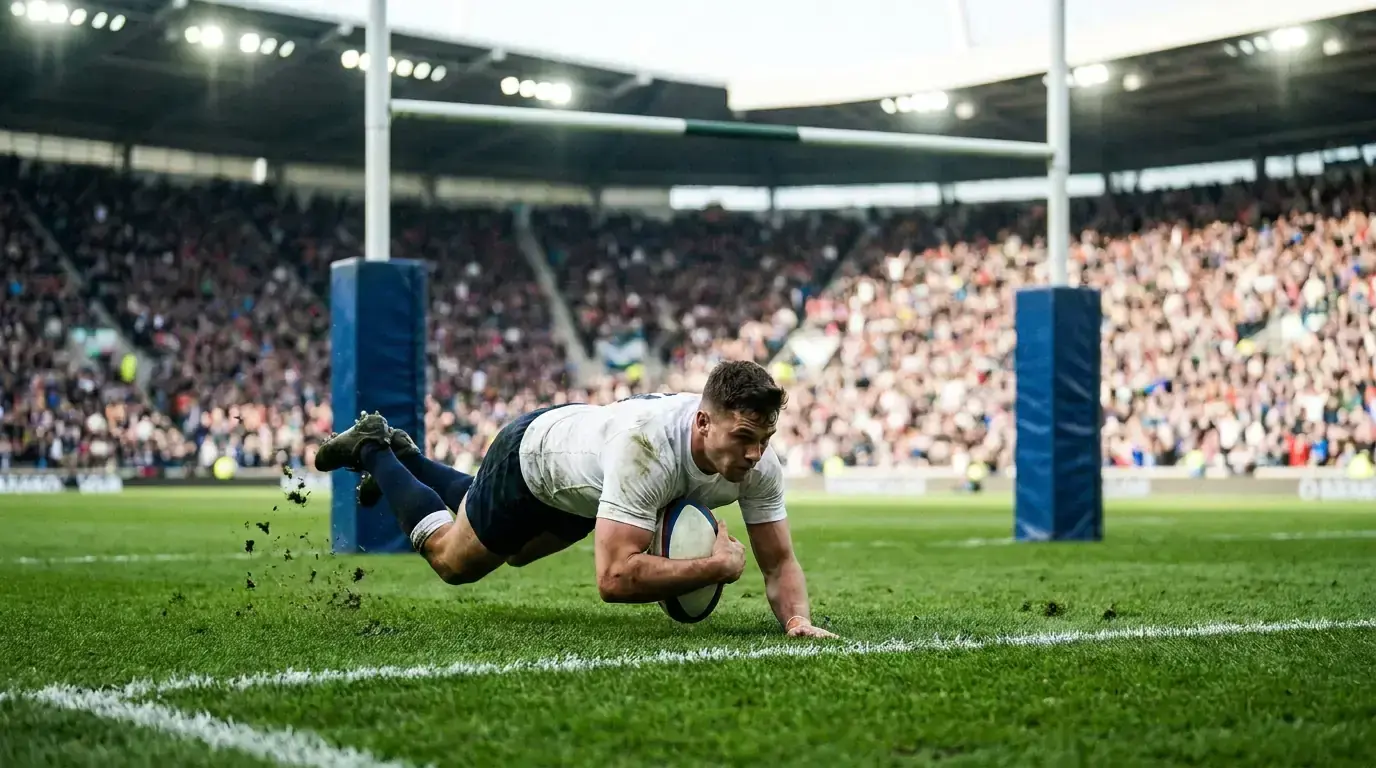
Average match totals reflect those values, with adjustments for pace and territorial styles. Six Nations matches sit around 51 total points. Super League averages closer to 42-44 in a typical regular-season fixture. Top 14 union runs around 47. NRL is often slightly higher than Super League because the pace is faster and the playing surface drier.
Pace differs more than the totals alone suggest. Rugby league is the faster game on a per-minute basis — six tackles, fast play-the-balls, less time spent in set-pieces. A typical Super League match clocks the ball in-play for around 56 minutes; rugby union averages closer to 35 minutes in-play because of scrums, lineouts, conversions, kickable penalties and TMO reviews. Bettors who underestimate union’s in-play time and overestimate league’s tend to mis-price scoring frequency markets in both directions.
Conversion percentages run slightly higher in league than in union because the conversion attempts are taken from along the angle perpendicular to where the touchline was crossed, with less set-piece restart pressure — but league kickers also operate without the in-game rest a union place-kicker gets between conversions during longer rucks. Different rhythms produce different accuracy distributions. Once you build models for both codes, you can see those rhythms in the over/under totals first.
Two Codes, Two Calendars, One Bankroll
For about three weekends in March every year, there are seven serious rugby fixtures on UK terrestrial and pay TV, split roughly even between union and league. Saturday lunchtimes are Premiership. Saturday afternoons are Six Nations. Friday nights are Super League. There is no off-season for the cross-code bettor in the spring, which is a working condition more than a complaint.
Union season runs September through June in the northern hemisphere. Premiership has 18 rounds across that span plus knockout, with a midwinter break for Six Nations. Six Nations occupies five weekends in February and March. The URC runs in parallel with Premiership, and the Champions Cup tournament rounds slot into December and the back end of the season. Autumn international windows in November bring the southern hemisphere into UK fixtures. The Rugby World Cup happens once every four years and Lions tours roughly every four years.
League runs the other way. Super League opens in February and closes in October, with the Grand Final at Old Trafford as the autumn climax. The Challenge Cup runs as a parallel knockout. NRL season is March to October — autumn in the southern hemisphere, which lines up almost identically with Super League by chance more than design. State of Origin is three matches across May-July. The Rugby League World Cup is also quadrennial, scheduled to avoid the union World Cup year where possible.

Commercial pressure has tightened both calendars. The Premiership signed a five-year television deal with TNT Sports worth £200 million through the end of the 2030/31 season — every Gallagher Premiership match plus playoffs and final on TNT Sports or Discovery+ — and that level of broadcast investment has pulled fixture-list scheduling more firmly into prime-time slots. League’s broadcast architecture is structured similarly, with the BBC and Sky carrying Super League and the NRL spreading across Channel 4 and streaming windows in the UK.
What this means for betting is overlap weekends. Three- and four-fixture Saturdays where union and league are both running attract the heaviest live-trading volumes of the year, and the markets price thinner because liquidity rises. If you trade both codes, those are your weekends. If you trade only one, you can use those weekends to study the other quietly without risking capital.
What Union Does That League Does Not
In a typical Premiership round there will be 18-20 named try-scorers in the union try-scorer book per fixture, plus the no try scorer option. In a Super League fixture, the named board sits closer to 14-16. That gap is not arbitrary — it reflects the positional reality that more union players can plausibly score from the run of play because of the contested-possession and set-piece structures.
Union markets are deeper across three specific dimensions.
Handicap range is wider. Six Nations handicaps stretch routinely to -20.5 or -25.5 in mismatches involving Italy or in autumn international fixtures where a tier-one nation plays a developing side. Spread bookmakers go further still, with sport-betting indices selling buys and sells at 20-30 points on uneven Test matches. League handicaps are tighter — Super League’s competitive balance and the six-tackle structure means -15.5 is already at the wide end of the regular-season book.
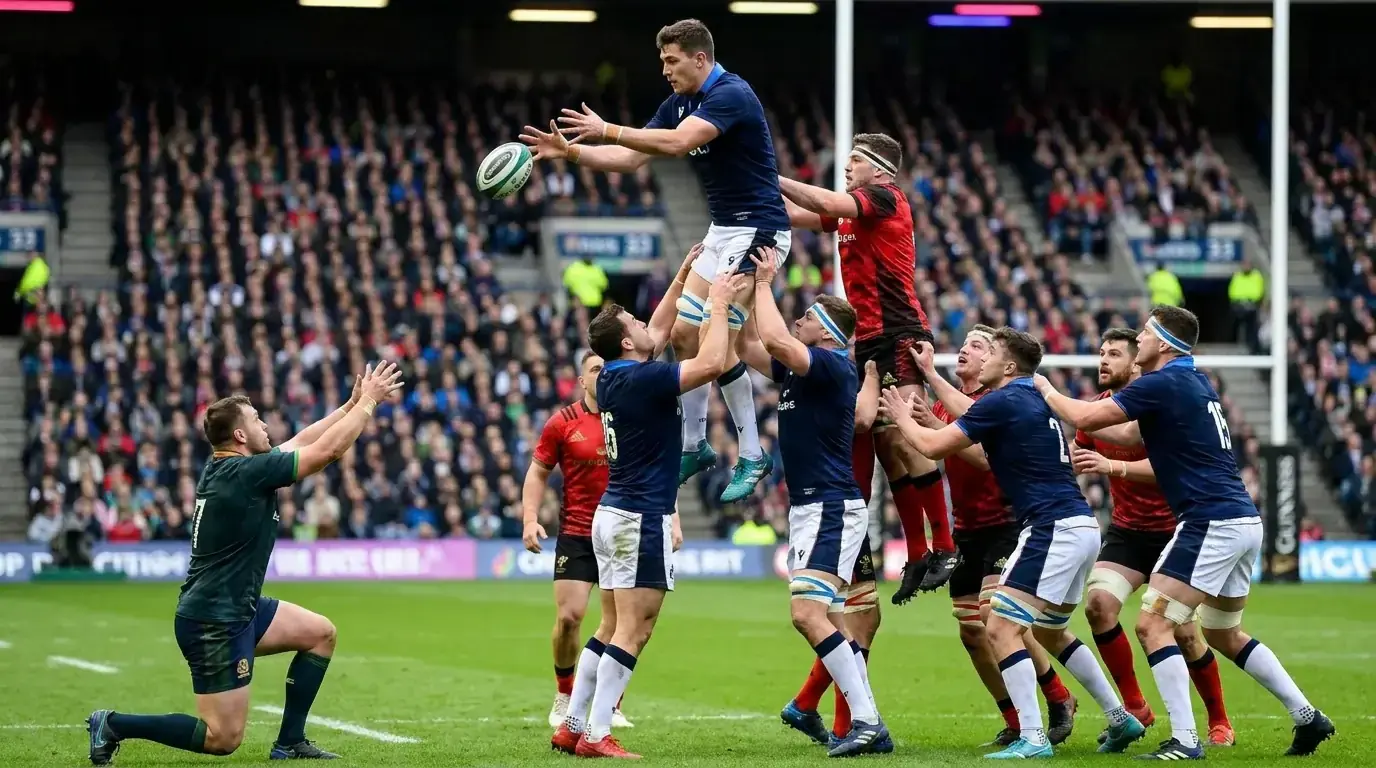
Try-scorer markets cover more positions. Backs in both codes, of course. Forwards score more frequently in union than in league, particularly in pick-and-go territory and from driving mauls. A union back-row forward might be priced 6/1 to score anytime in a tight match. A league second-row, despite being in a similar position structurally, scores less because the play-the-ball reset reduces close-range carrying opportunities for forwards. The try-scorer market reflects that asymmetry directly.
Kicker markets are richer in union. Place-kickers in union take penalties to goal multiple times per match — a fly-half might attempt five or six. League fly-halves and full-backs take far fewer penalty kicks because penalties are worth only two points and most are kicked to touch for territory rather than at goal. Kicker total-points, kicking accuracy and player props on goal-kicking are wide-margin markets in union and thinner in league.
Match length is identical at 80 minutes, but the in-play time inside that 80 differs by roughly 20 minutes per match, which means the in-play book in union has fewer scoring-play decision points than league but more set-piece decision points — turnovers won at the breakdown, lineout pinches, scrum penalties. The information asymmetries in union live betting cluster around those set-piece moments, and that is where the value tends to sit.
What League Does That Union Does Not
Race-to-points markets are league’s signature pricing product. First team to 10 points, first to 15, first to 20 — these settle faster in league than in union because tries are more frequent and the scoring rhythm is more continuous. A Super League match averages roughly two and a half tries per side; first-to-10 settles inside the opening 25 minutes more than half the time.
Set-of-six dynamics drive their own family of in-play markets. Bookmakers price metres made per set, completion rates, attacking line breaks per six-tackle set. These are bets that simply do not exist in union because the structure is not there to support them. A team that strings six clean sets together in attack will probably score, and the in-play match-winner adjusts before the scoreboard does.
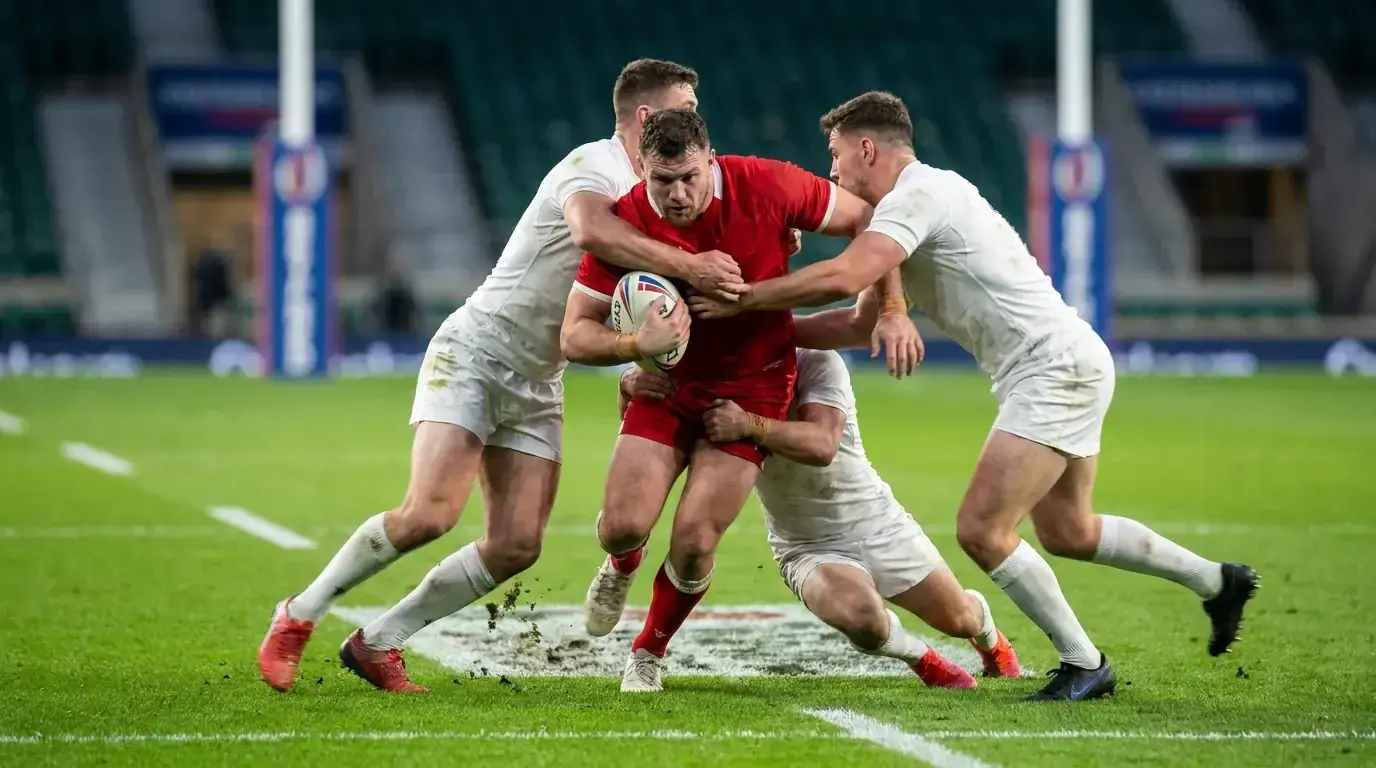
Try-scorer markets in league hit more often than in union, which makes anytime try scorer a higher-volume bet. Margins on it sit slightly tighter than in union — typically 10-12% rather than 12-15% — because the operator has more data and more confidence in pricing. Wingers are routinely 11/8 or shorter for anytime in NRL fixtures involving heavy try-scoring sides.
Golden point — the NRL’s overtime rule, where the first team to score in extra time wins — adds a betting layer union does not have. Pre-match in-play tie markets price the golden point separately. Super League has historically resolved its drawn matches differently (golden-point rules adopted in cup competitions but not always in regular season), so check the competition rules before staking.
Disciplinary markets behave differently. League’s emphasis on quick play-the-ball means defensive tactics that disrupt that flow draw cards more frequently than they do in union. Total-card markets in NRL hit over 4.5 in a competitive match more often than total cards in a comparable union fixture.
For the bettor moving from union into league specifically, the strategic shift is from set-piece-driven thinking to phase-rate thinking. You are pricing not what happens at the scrum or lineout but what happens across each set of six. For a fuller account of pricing dynamics specifically across the Super League season, see this full Super League betting guide.
Where the Books Are Thicker and Thinner
A clean head-to-head match-winner book on a Premiership Saturday will run an overround of around 4.2-4.8%. The same book on a regular-season Super League fixture will sit slightly wider at 5.0-5.6%. That two-thirds-of-a-percentage-point difference looks small but compounds across hundreds of bets, and it is one reason serious value-hunters tend to grow into union over time before reaching league.
Why thinner margins in union? Three answers. Larger pre-match betting volumes per fixture, which lets operators trust their pricing more and run thinner overrounds. More competing data providers building independent models against the same fixtures. And a broader commercial market — the 2023/24 season saw ITV viewership records smashed for The Showdown 5 at Tottenham Hotspur Stadium between London rivals Saracens and Harlequins, and again for the Gallagher Premiership Rugby Final 2024, the kind of broadcast event that keeps competition for punter share intense.
Why thicker margins in league niche markets? Smaller volumes, smaller specialist data ecosystem, and a more concentrated set of operators with edge in that book. The wide market in league — match winner and handicap on Super League — has tightened over the last three seasons. But specials, exotics and lower-tier league fixtures such as Challenge Cup early rounds carry overrounds that can exceed 15% on match-winner alone, double the typical union number for an equivalent fixture.
Pricing on dominant favourites diverges sharply between the two codes. A 1/14 favourite in union — South Africa hosting Romania in an autumn international, for example — is not unusual. League favourites rarely shorten past 1/4 or 1/5 in domestic competition because the six-tackle structure caps how decisively a single side can dominate. State of Origin and NRL Grand Final pricing sits inside a 5/4 versus 4/6 range almost every year, regardless of regular-season form.
Margins matter because they compound. A bettor who trades both codes at the wider end of the league book will lose ground to the same bettor trading at the tighter end of the union book, even if their pre-market reads are identically accurate. Understanding which fixtures are priced where is itself a small edge.
Who Watches, Who Bets, Who Cares
Eighteen percent of UK rugby fans placed an online sports bet in the past twelve months, against 49% for horse racing fans, 23% for football and 21% for cricket. Rugby is a niche-but-premium bettor segment in the UK — fewer punters than football has, with larger stakes per ticket and a stronger lean toward analytical engagement. Knowing where you sit inside that profile is part of knowing how to compete.
Tournament-level attendance numbers in 2025 made the same point in different ways. The Men’s Six Nations drew 1,050,465 spectators across 15 matches — average 70,031 per fixture — and produced 108 tries at 7.2 per game. The same tournament generated $135.24 million in media-rights revenue from broadcast deals with the UK, France, Italy and Ireland. Those numbers are the scale of the audience that pricing engines are betting against.
League’s audience is sharper geographically — concentrated in northern England, the Catalans region of France, Australia and New Zealand — but no less commercially serious. Super League and NRL combined draw weekly fixture audiences in the millions. The bettor demographic skews slightly younger in league and slightly more male in both codes. Mobile-first betting behaviour applies across both, with the typical league bettor doing more in-play than the typical union bettor — partly because league fixtures cluster on Friday and Saturday evenings when in-play handles peak.
For the cross-code bettor, the practical implication is that competition for value differs between the two codes. Union markets attract more analytical bettors per fixture. League markets attract more recreational bettors per fixture, which sometimes opens niche-market value in league that does not exist in union. Knowing that asymmetry is a small but useful input when deciding where to spend study time.
Switching Codes Without Switching Models by Mistake
Three years ago I dropped a four-figure ticket on a Saturday afternoon Super League fixture using a model originally calibrated for Premiership union. The model said the underdog at +14.5 was a clear value pick. The match finished underdog -22. I had failed to account for the six-tackle structure capping how quickly the favourite could pull away in a way that union’s contested possession would have prevented. The favourite did not pull away gradually — they scored three quick tries in a single set-driven 12-minute burst and the spread was gone. Model error: cross-code transplant, the most common mistake new dual-code bettors make.
If you are moving from union into league, the major recalibrations are: lower scoring values per try (4 not 5); higher per-minute scoring rate; faster ball-in-play time; tighter handicap range; sharper short-burst scoring runs; less impact from set-piece weakness; more impact from completion rates and error counts.
If you are moving from league into union, the recalibrations run the other way: higher scoring values per try; more scoring from sustained phase pressure; longer set-piece time; wider handicaps; bigger upset rarity in the same league/Test environment; more impact from kicker accuracy and ref strictness at the breakdown.
Try-scorer markets are where cross-code mistakes hit hardest, because positional intuition does not transfer cleanly. A power back in union is not necessarily a high-frequency scorer in league, and a centre with five tries in five Super League rounds is not necessarily going to be a try-machine in union if he transfers across the code line.
Bankroll behaviour also matters. Two codes means more fixtures, more opportunities, more bet count per week. The honest bettor draws a line on how many fixtures they will trade in any given weekend and which code gets primary attention. Spreading thin across two codes simultaneously is a quiet way to lose money to attention deficit rather than to model error.
Cross-Code Questions Bettors Keep Asking
Two Sports, Two Models, One Discipline
There is no single rugby betting model. There is union betting, and there is league betting, and the moment you pretend the two are interchangeable is the moment your tickets start losing for reasons that have nothing to do with bad luck.
What carries across both codes is the discipline. Read the settlement rules. Understand the overround. Build separate probability reads for each code before you stake. Respect the integrity-aware boundaries that apply to both — Reg 6 on the union side and Operational Rules on the league side bind players and connected persons the same way, and the markets are policed accordingly.
What does not carry across is positional intuition, scoring math, handicap calibration or pace assumption. Each of those needs its own dedicated work for each code. The bettor who treats union and league as two competence areas rather than one usually ends up with a better record in both — partly because the dedication to each code forces a level of detail that a single rolled-up model cannot reach.
Two sports. Two models. Same person reading them, just doing the work twice.
