


Drop goal markets are the rugby betting category where the analytical work most consistently outperforms casual market opinion. Drop goals are rare — Premiership matches average roughly 0.4 drop goals per match across the recent seasons, and Six Nations fixtures average closer to 0.6 — but the strategic value of a single drop goal in a tight contest is significant enough that the markets carry meaningful pricing depth across every televised competition. The combination of rarity and outsized impact is exactly the structural profile that produces edge for the bettor willing to put in the preparation.
I worked drop goal markets seriously for the first time during the 2019 World Cup cycle, and the data set across the cycle confirmed what I’d suspected: the operator’s pricing models were systematically underweighting the drop-goal probability in tight late-game scenarios, and the in-play prices were lagging the actual game state by enough to produce repeatable value. The same structural inefficiency persists in 2026, and the markets remain one of the more reliable analytical-edge categories in the sport.
The Mechanics of the Market
A drop goal in rugby union is worth three points. The kick is made from open play, with the ball dropped from the hands and struck on the half-volley as it bounces. The kick must clear the crossbar between the uprights to score. The same kick in rugby league is worth one point — the structural difference reflects the different scoring rhythms of the two codes, with the union value sitting at the same point value as a penalty kick and the league value sitting at a tactical-utility level rather than a scoring-equivalence one.
The 2026 experimental rule trial in selected competitions introduces a 2-point drop goal — applied to drop goals taken from beyond a defined distance from the posts, in a structural mirror of basketball’s three-point line. The trial is running in a small number of competitions through the 2025-26 and 2026-27 seasons, with the operator settlement rules typically treating the 2-point drop goal as a standard drop goal for market purposes (i.e. a successful 2-point drop counts as one drop goal for “drop goal scored yes/no” markets) but as a separately settled event for any value-based markets.
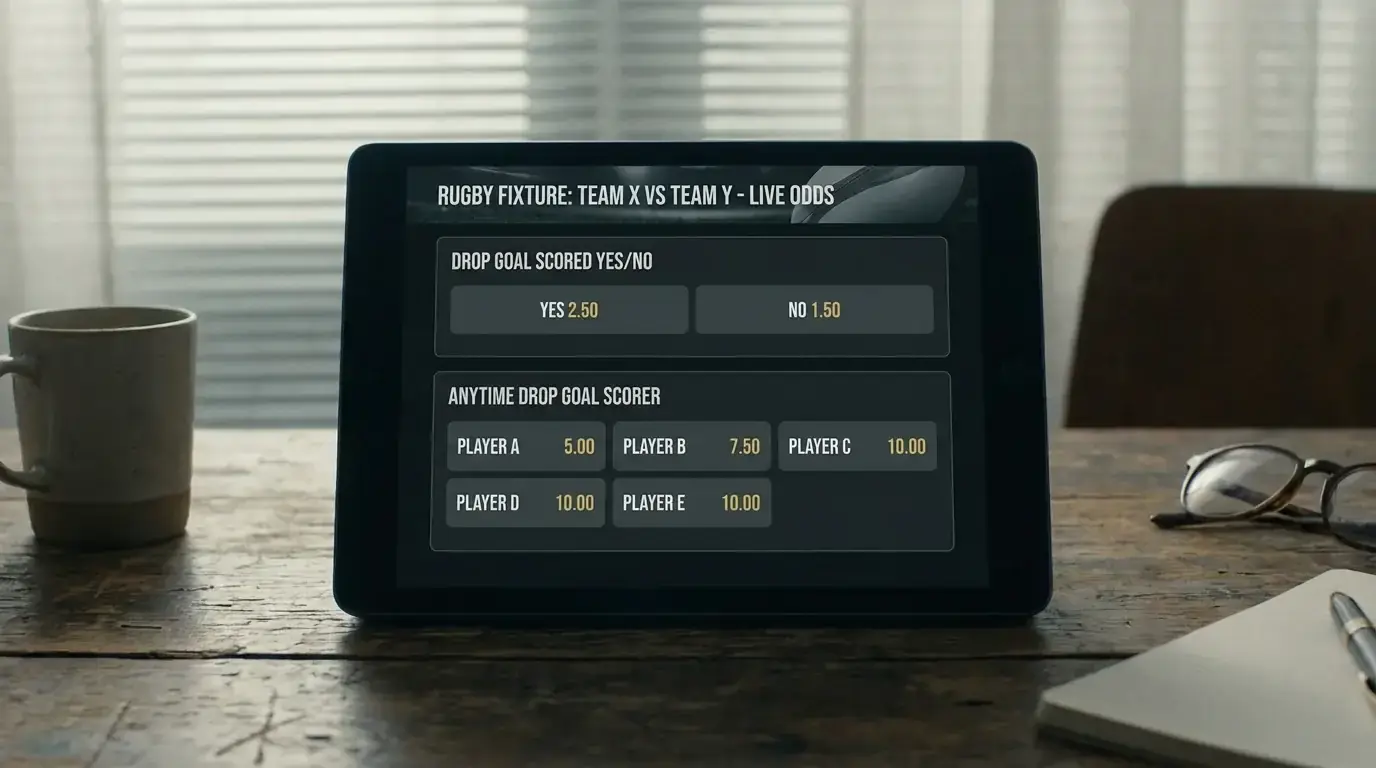
The standard drop goal markets are: drop goal scored in match (yes/no), anytime drop goal scorer (specific named players), team to score a drop goal (home/away/neither), and total drop goals over/under (with the line typically set at 0.5 or 1.5 depending on the fixture). The operators offer these markets pre-match and in-play, with the in-play pricing updating after each phase of play based on score state, time remaining and field position.
The Historical Patterns Across Teams
Through ten years of structured rugby data, the drop-goal usage patterns at international level cluster clearly. France and England are the two highest-frequency drop-goal teams in the modern era. France in particular has produced multiple defining drop-goal moments across the last three Six Nations cycles, with the side’s fly-half rotations consistently selecting players with strong drop-goal capability. England’s drop-goal tradition runs back through Jonny Wilkinson’s era and has been maintained through subsequent fly-half generations, with the tactical option being deployed roughly twice as often per match as the international average.

The southern hemisphere sides — New Zealand, Australia, South Africa, Argentina — show meaningfully lower drop-goal usage. The All Blacks have historically preferred the maul-and-kick-penalty route for three-point scoring, with the drop goal reserved for very specific late-game tight-score scenarios. The Wallabies and Pumas show similar patterns. The Springboks have used drop goals more frequently in the recent cycles, but still at frequencies below the European averages.
The Pacific Island sides (Fiji, Samoa, Tonga) show the lowest drop-goal frequencies of any tier-one rugby nations, reflecting their tactical preference for running rugby and the structural reality that drop-goal practice time is limited in their playing structures. The Tier 2 nations more broadly produce variable drop-goal patterns depending on the specific squad composition and fly-half selection.
The Late-Game Relevance and the Wilkinson Effect
The single drop goal most rugby supporters will remember from the modern era was Jonny Wilkinson’s strike in the closing minutes of extra time in the 2003 Rugby World Cup final against Australia. England trailing 17-17 in extra time, the ball worked through the phases, the recycle to Wilkinson, the right-foot drop goal sailing through the posts. The structural significance of that strike — beyond the tournament outcome — was that it established the drop goal as a strategically deployable late-game weapon at the very highest level of the sport, and the operator pricing models have been recalibrating around the precedent ever since.
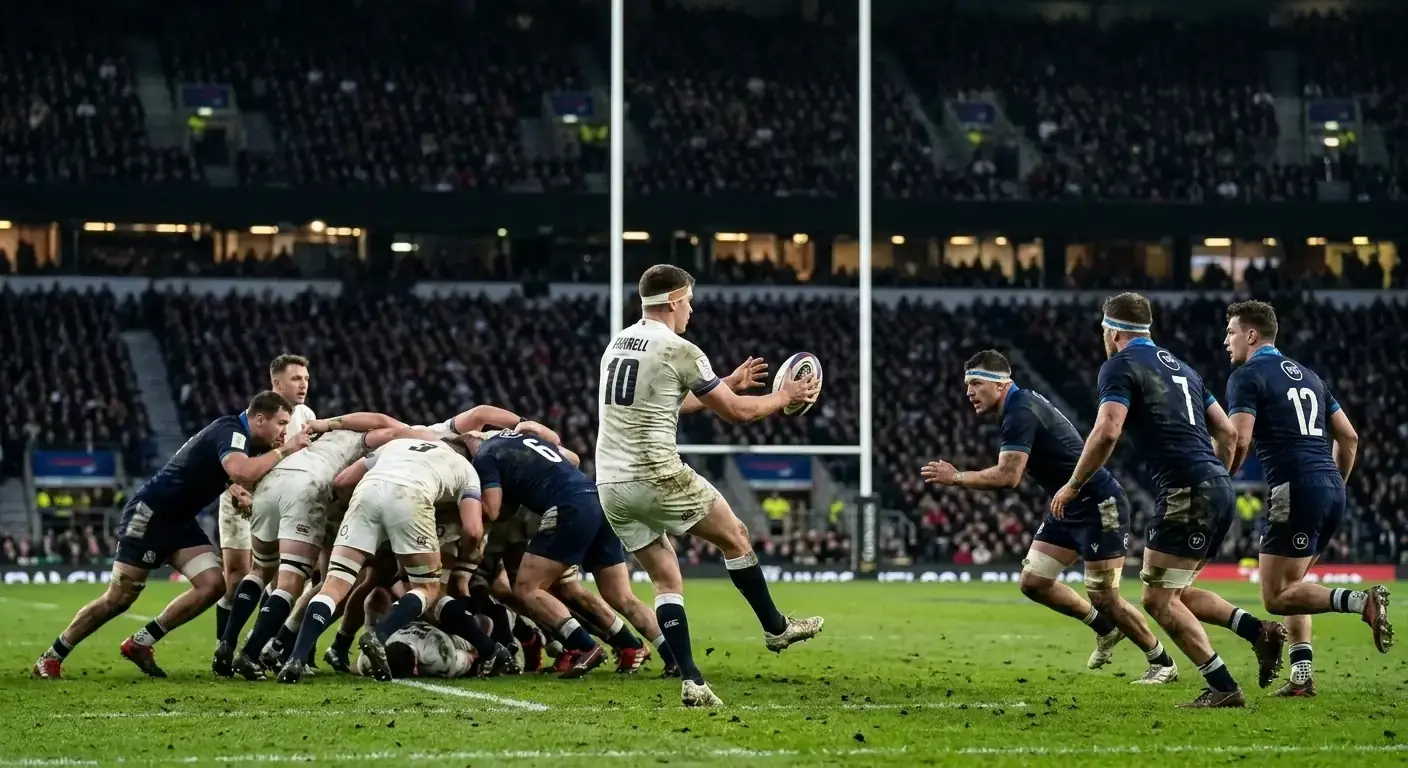
The post-2003 pattern has been consistent: tight matches at any senior international level produce drop-goal attempts at significantly higher rates than the match-long averages suggest. The structural driver is straightforward — when the score is within a converted try, the marginal value of a three-point drop is significantly higher than the marginal value of building phases for a try attempt, and the tactical preference shifts accordingly. The operator’s in-play pricing models capture this shift, but they capture it with a lag — typically 30-60 seconds behind the actual game state — and that lag is where the in-play drop-goal edges live. For the structural understanding of how late-game scoreline pressure feeds into the broader winning margin markets, my winning margin markets in rugby piece breaks down the bucket structure and the late-match repricing dynamics in detail.
The specific in-play pattern I work to is this: when a tight match enters the final 10 minutes with the score within six points and the trailing side in possession in the opposition half, the operator’s drop-goal-yes price typically lags the true probability by 15-25%. That’s a meaningful enough edge to be tradeable, and the structural pattern repeats consistently across the major competitions.
Player Drop Goal Markets and Where the Pricing Sits
The anytime drop goal scorer markets are the deepest player-specific pricing layer in modern rugby betting. The operators price up named players based on their historical drop-goal frequency, current match assignment (starting fly-half versus replacement, full match versus impact), and the expected match state context. The first-choice fly-half for any side is invariably the shortest price in the market, with the replacement fly-half offered at meaningfully longer odds, and a handful of other potential drop-goal-takers (the inside centre, occasionally the scrum-half) appearing at longer prices still.
The structural patterns that drive the player-specific pricing are well-documented. Drop goals are kicked almost exclusively by fly-halves — roughly 85% of all drop goals at senior international level over the last decade have been kicked by the starting or replacement fly-half. The inside centre kicks roughly 8-10% of drop goals, typically in matches where the centre is a converted fly-half (England’s Owen Farrell-era at inside centre, France’s Jonathan Danty alongside fly-half partners). The remaining 5-7% of drop goals are split between scrum-halves taking on the kicking duty in specific tactical scenarios and the occasional surprise drop from a back-row forward or a fullback in unusual circumstances.

The operator’s pricing on the first-choice fly-half typically sits at 5/1 to 8/1 for anytime drop goal scorer in a standard fixture, climbing to 3/1 to 5/1 in matches where the side is expected to be in a tight close-out scenario. The replacement fly-half is typically priced at 25/1 to 50/1, with the value depending heavily on whether the bench fly-half is expected to play a significant portion of the second half. The inside centre — where the inside centre is a known drop-goal-taker — typically sits at 12/1 to 20/1.
Union Versus League and the Different Market Structures
The drop goal markets in rugby league are meaningfully different from the union markets because of the different point value. A league drop goal is worth one point, which gives it a tactical-utility role rather than a scoring-equivalence role. Drop goals in rugby league are kicked primarily in tight late-game scenarios when one point is the difference between winning and a draw, and the operator’s pricing on league drop goals reflects this concentrated usage pattern.

The pre-match drop-goal-yes markets in rugby league typically price at 6/4 to 9/4, reflecting the higher proportion of league matches that finish within one converted score and therefore feature late-game drop attempts. The equivalent union market typically prices at 11/8 to 7/4, reflecting both the lower per-match drop frequency and the different score-state patterns. The two codes’ markets aren’t directly comparable in terms of value distribution, but the underlying structural insight — drop goals cluster in tight late-game scenarios — applies in both.
The cross-code crossover at player level matters less for drop-goal markets than for many other rugby markets. A union fly-half moving to league rarely brings the drop-goal pattern with them — the tactical structure of league rugby produces fewer drop opportunities, and the player adapts to the receiving code’s patterns rather than transplanting their union-era frequency. The operator pricing on cross-code players for drop-goal-related markets reflects this adaptation pattern within a season or two of the transfer.
The Mental Model That’s Served Me Best
The single piece of structural insight that’s produced the most consistent results for me in drop goal markets is treating the pre-match drop-goal-yes position and the in-play drop-goal-yes position as two completely separate analytical exercises. The pre-match position is a function of team tactical disposition, fly-half selection, expected score patterns and weather (drop goals are slightly less likely in heavy rain or strong cross-winds because of the handling and kicking implications). The in-play position is a function of current score state, time remaining, possession location and recent attacking momentum.

The operator pricing on both markets uses the same underlying drop-goal probability model, but the two markets have different structural drivers, and the analytical work that produces edge in one doesn’t necessarily produce edge in the other. The pre-match work pays off through patient position-building across the calendar — backing the higher-frequency teams (France, England) at value prices when the operator’s pricing models haven’t fully adjusted for recent fly-half selections. The in-play work pays off through quick recognition of the tight-late-game pattern and willingness to take the position before the operator’s model fully reprices. Both are profitable approaches, and the structural distinction between them is what makes drop goal markets one of the more rewarding niche categories in rugby betting.
