


Walk into any UK bookmaker the morning of a Saturday Six Nations fixture, pull up the market list on your phone, and start scrolling. Match winner, handicap, total points, try-scorer for every starter and most replacements, half-time leader, race-to-points, winning margin bands, drop goals, disciplinary specials, anytime tackle leader. Past 150 individual markets per major rugby fixture is now the standard, and that catalogue is the modern rugby bettor’s working environment.
A rugby betting market — and this is the definition I keep returning to after a decade trading these books — is a contract with a specific settlement rule. The bookmaker offers a price on a defined outcome. You stake. The match plays out. The settlement rule decides who collects. Everything else is decoration. The trouble is that the decoration is what most beginners read first, and the settlement rules are what they look at only when something has gone wrong.
That is the lens I will use across this guide. Each market type gets a clear definition, an example with real fractional odds, and the settlement edge case that catches people out. I am not telling you which to bet — pricing changes weekly and operator-specific recommendations age fast. I am telling you what each market means and how the bookmaker’s book on it is built. With in-play wagering now sitting above 70% of all online sports betting volume in the UK against under 30% a decade ago, the modern bettor needs to read these markets as fluently mid-match as before kick-off, and that starts with knowing what each one actually pays out on.
Match Result and the Two-Way, Three-Way Question
In the 2018-19 Premiership season, Saracens drew with Wasps 27-27 at Allianz Park, and I watched four pricing tickets from that day land at settlement on the same desk. Three were 2-way match-winner bets, all losing on the dead-heat technicality. One was a 3-way bet on the draw at 22/1 the morning of the game, paying out for the punter who took it. Same match, same scoreboard, four different outcomes — because the markets were different contracts.
That is the first decision every rugby bettor makes before staking anything: which match-result market are you actually in?
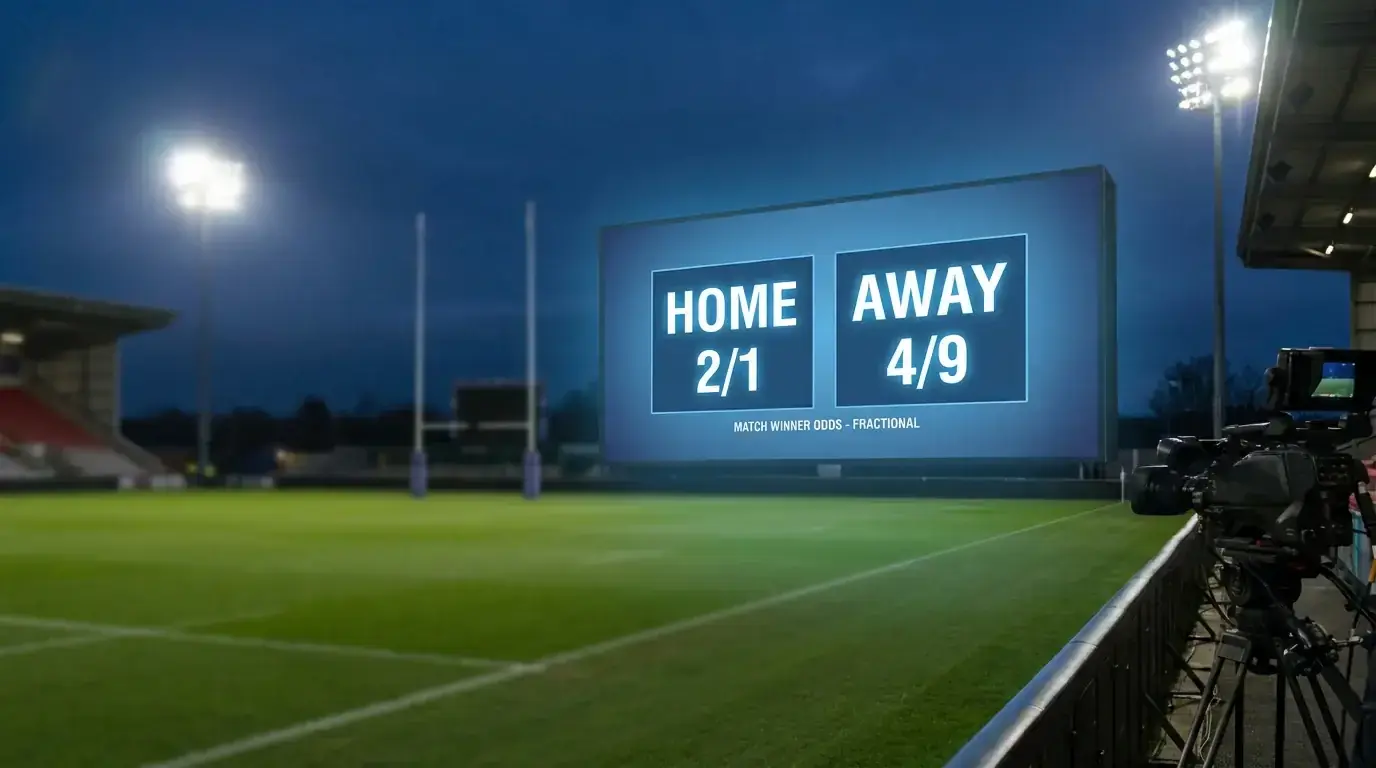
Two-way match winner offers two prices, Team A or Team B, and a tie pays nobody. Most UK bookmakers default to two-way for big international fixtures and Test rugby, partly because draws are statistically rare in international 80-minute matches and partly because the simpler the book, the tighter the operator can run the margin. Settlement is binary — if the scoreboard at full-time names a winner, that side collects. If it does not, because of an injury-time conversion that levels the score for example, the entire two-way book is voided or refunded depending on the operator’s rules. You always check that in the terms before staking, never after.
Three-way match winner adds a draw as a separate selection. Gallagher Premiership and the United Rugby Championship typically price this way, and the draw line tends to sit somewhere between 18/1 and 30/1 in evenly-matched fixtures. The reason it is not 50/1 or higher is that ties in club rugby happen about 1-2% of the time across a full season — uncommon, not negligible. A Premiership draw priced at 28/1, for instance, implies a 3.4% chance once you back out the overround. The market is telling you the operator’s book thinks the true probability is closer to 2%, with the rest baked in as house edge.
The settlement nuance to learn here: extra time in knockout fixtures usually does not count toward two-way or three-way match-result markets. Those bets settle on regulation 80 minutes. The longer your book, the more the bookmaker’s edge compounds — which is why match-result remains the lowest-margin product on the board and the place I tend to start any new fixture’s price discovery.
Handicap Markets and the Logic of Rugby Spreads
France versus Italy at the Stade de France usually opens with a handicap line somewhere around France -22.5. I have priced this fixture dozens of times across Six Nations and autumn-international slots, and the spread tells you more about expected match shape than the outright odds do. A 22.5-point French line is the bookmaker’s polite way of saying we expect France to win by roughly three converted tries, but we are not certain about the margin.
That is what a rugby handicap market is — a virtual point adjustment applied to the final score for settlement purposes. You back the favourite minus the points or the underdog plus the points, and settlement runs against the adjusted total.
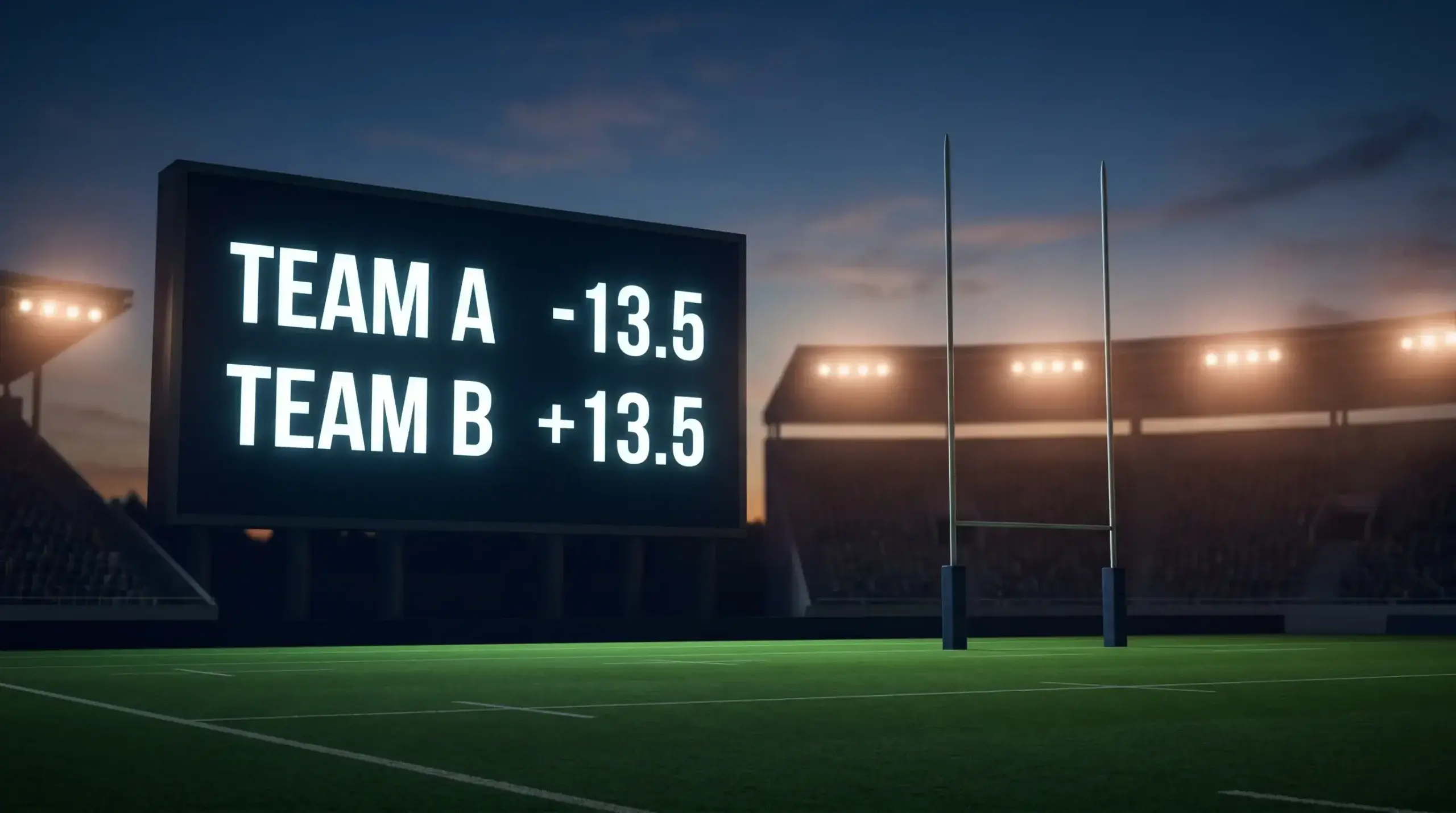
Asian handicap is the version most UK punters meet first. Two outcomes, no draw, with a half-point line — the 0.5 — used to eliminate ties. France -22.5 and Italy +22.5 is the same line stated two ways. If France wins by 23 or more, the France -22.5 ticket settles as a winner. By 22 or fewer, it settles as a loser. The Italy +22.5 ticket settles the opposite way. Clean, binary, no push.
European 3-way handicap, sometimes called handicap with draw, prices three outcomes: favourite covers, underdog covers, or the adjusted line lands exactly. A -13/+13 line in a Premiership match offers Team A -13, Team B +13, and the handicap draw at 13. If the favourite wins by exactly 13, the third option collects, often priced at 15/2 to 12/1 depending on how the operator reads the fixture. The favourite and underdog handicap selections lose. This is where rugby specifics matter — try-and-conversion arithmetic means 7-point swings, so 13- and 14-point handicap draws are non-trivially common.
Where rugby handicaps stretch wider than football is the simple fact that score differentials in rugby compound. One try lead becomes two within ten minutes of yellow-card pressure, and once a side opens up by 20 the underdog often packs in and the gap widens further. Live betting represents a considerable share of overall rugby wagering, with market adjustments occurring rapidly during active play — market values may adjust quickly in response to factors such as possession changes, injuries, or substitutions, and the handicap is the market that reacts first.
The settlement edge case to remember: a handicap match that ends with an abandonment in regulation 80 minutes is usually voided rather than settled at the moment of abandonment. Check the operator’s specific rules before you stake anything that exposes you to weather-driven or injury-driven match termination.
Totals: Over, Under and the Team Variant
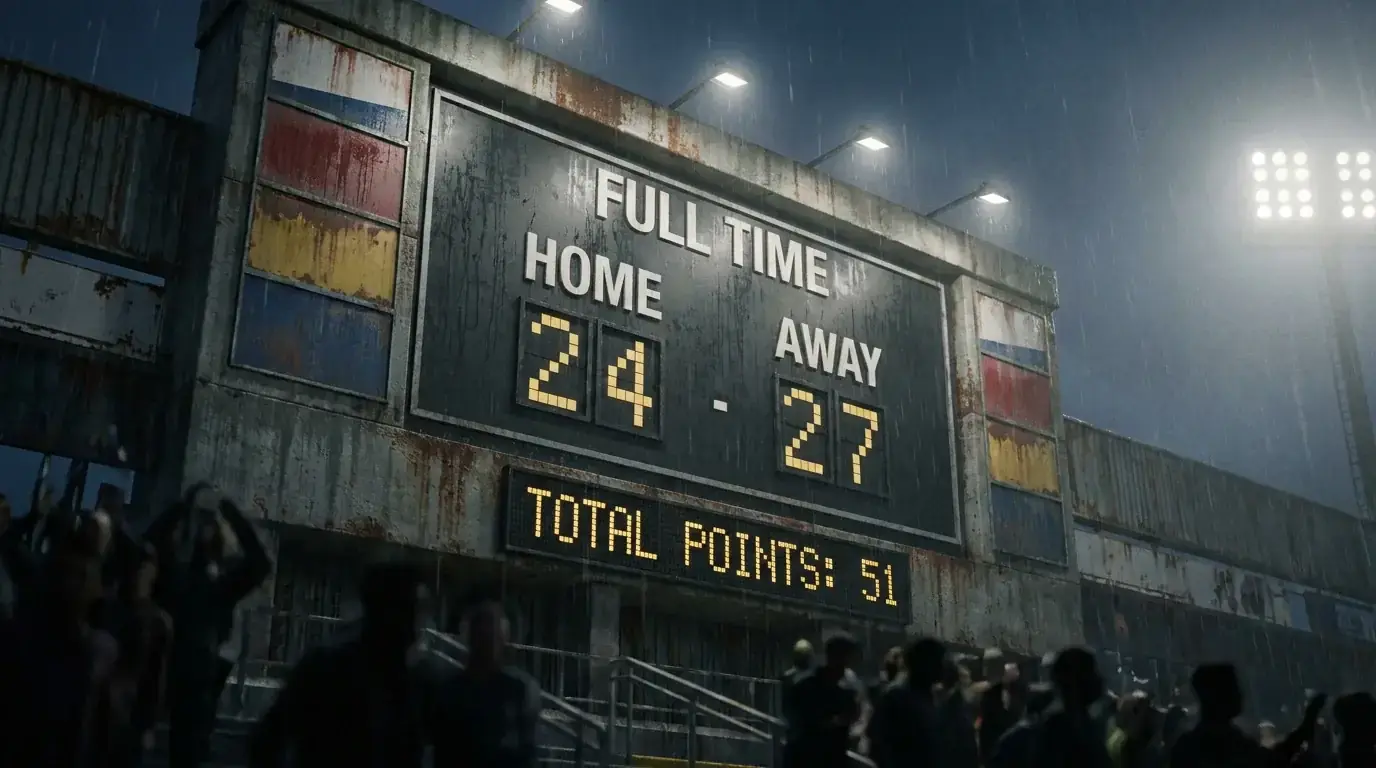
Compare two over/under lines from the same weekend in March 2025: France versus Ireland at the Stade de France priced over/under 51.5 points, and a Top 14 fixture between Toulouse and Lyon priced over/under 41.5. Same sport. Same code. Same month. A ten-point gap in the operator’s expected total because the fixture, the venue, the playing surface and the historical scoring patterns of the two competitions differ that much.
Totals — over and under on combined points — rewards bettors who understand how the specific competition scores, not just how the two teams are ranked. Six Nations matches in the modern era average around 51 total points per fixture once you strip out outliers. Gallagher Premiership averages closer to 47. Top 14 has historically run lower because of weather, surface and a defensive philosophy that prizes territorial kicking over open-field running. Super Rugby Pacific averages above 60 in many seasons. The over/under line is the bookmaker’s read of all these factors stacked together.
Team totals work the same way at half the scale. France’s team total over/under in an evenly-matched Six Nations fixture sits around 25 or 26 points. Italy’s might be 16. The line for each side is essentially the bookmaker’s projection of how that team will score, considered independently of the opposition. You can back over on one team and under on the other, which is functionally a derivative bet on the spread.
Half totals — over/under on combined first-half points or second-half points — is where rugby specifics get sharp. First halves in rugby union average roughly 22 points and second halves 28, because of the cumulative effect of fatigue, substitutions and pace changes. Backing over on the second-half total is a different bet from backing over on the full match, and the implied probabilities reflect that.
In all of these, settlement is mercifully simple. The scoreboard at full-time decides. The traps are pre-match, not post — a market opened on the assumption of dry weather that becomes a downpour by kick-off, or a line that does not adjust quickly when a starting fly-half is replaced 90 minutes before the match. Those gaps are where the over/under bettor lives or dies.
Player Markets and the Math Behind Individual Bets
There are more player markets on a single 2026 Premiership fixture than there are starters on the pitch — and that is by design. UK punters place roughly 290 million online bets a month across all sports, and the volume demands granularity. Player props are where the bookmakers serve it.
I will treat try-scorers as a separate sub-discussion below because they deserve it. The rest of the player market book is worth understanding on its own terms. Man of the match is the lowest-margin player bet most UK books offer, with an overround that often runs north of 20% because outcomes depend partly on subjective broadcast voting. You are not betting on who played best — you are betting on who the panel will agree played best. Those are different bets.
Metres run, tackles made, line breaks completed and kicking accuracy bets are the data-driven player props. These have hardened over the past three seasons as broadcast tracking data has improved. A scrum-half with a metres-run line of 28.5 in a Premiership fixture is, in the operator’s read, the median expectation across the past dozen games. The over/under sits on whether his actual metres land above or below that line. Forwards’ tackle counts work the same way — Tom Curry priced over/under 14.5 tackles is a routine line in a high-intensity Test match.
Kicker markets are their own niche. Goals from hand, drop goals scored, penalties converted from outside a specified range. Kicking accuracy bets settle on percentage-conversion thresholds — over 70% or under 70% kicks at goal completed by a named place-kicker. These move sharply on team news. If the starting kicker is replaced 30 minutes from kick-off because of a calf strain, that whole sub-book on player props collapses and reopens against the replacement’s historical rate.
Player props are also where bet builders draw most of their legs from, which is the bridge into the next section.
Try-Scorer Markets: First, Anytime, Last
Saturday, 9 March 2024. Italy versus Scotland in Rome. Juan Ignacio Brex crosses for the opening try inside the first ten minutes. A first-try-scorer ticket on Brex at 8/1 settles before most viewers have finished their first coffee. That is the market in a sentence: pure prediction, priced wide, settles fast.
First try scorer carries the highest margin of any player market in rugby — average bookmaker overround on this book often sits between 18% and 25%, which is roughly double the margin on a clean match-winner book. The reason is that probability is distributed across 23 named players plus a no try scorer option for low-scoring matchups. Even the favourite at the top of the board rarely shortens past 4/1.
Anytime try scorer is the same pool of names but with a different settlement rule. The bet wins if your selection scores at any point in regulation, not just the first try. Margins on anytime are tighter — typically 12-15% — because individual probabilities are higher and the operator can price more confidently.
The positional bias matters more than newcomers realise. Across the 2023 Six Nations, backs scored 66% of all tries and forwards 34%; in the first half of matches, that backs share rose closer to 70%. Wingers, centres and fullbacks are the natural finishers in modern rugby union because the modern attacking template moves the ball wide before scoring. Forwards score more in close-quarter pick-and-go situations near the try-line, which means their try counts cluster in the second half when defences are tired and discipline penalties have been earned. A first-try-scorer market that does not reflect those positional patterns — a forward priced shorter than a winger of comparable form, for example — is mispriced in the way I look for.
Last try scorer is the same book in reverse. Settlement rule: the player who scores the final try of the match, regardless of who scored before. Margins are similar to first try. The information edge is harder to capture because endgame patterns depend on game state — chasing teams use bench backs, leading teams burn clock with forward carries.
Two-plus tries is the harder, higher-margin variant: the selection must score at least two tries. Almost always paired with named hat-trick contenders and dominant wingers facing weaker defences. Margins north of 25% are normal.
For a deeper view of first-try-scorer pricing specifically, including positional probabilities and dead-heat rules, see this deep-dive into first try scorer markets.
In-Play Markets During an 80-Minute Window
Minute 42 of an England-France Twickenham fixture, 2025 Six Nations. Marcus Smith intercepts a flat pass in his own 22 and sets off downfield. The in-play match-winner odds on England shift from 5/2 to 9/4 to evens in the eleven seconds it takes him to be hauled down 30 metres from the French try-line. By the time the recycled phase resets, England’s line has shortened again. I have watched live odds move that fast hundreds of times, and the lesson stays the same: in-play rugby is a market where you are not betting on a state, you are betting on a trajectory.
In-play wagering is over 70% of all online sports betting in the UK now, up from under 30% a decade ago. The shift is not subtle, and rugby is one of the codes where it changes the betting experience most. The phased, possession-heavy structure of the game gives the bookmaker — and the bettor — far more decision points than football’s continuous flow.

The core live markets fall into a few buckets. Live match winner is the headline number, recalculated continuously based on scoreline, time remaining, possession territory and red-card status. Race-to-points bets — first team to 10, 15, 20 points — open at fixed lines and close fast as the scoring opens. Next score bets settle on whatever scoring play happens next, with try, penalty, drop goal and conversion priced independently. Ten-minute interval bets work like inning bets in cricket: highest scoring team in minutes 0-10, 10-20, 20-30 and so on.
Yellow-card swings are the in-play moments worth understanding. A ten-minute sin bin in a tight match changes win probability by 8-12 percentage points on average, depending on which team loses the player. Markets reprice immediately. The window for value is the gap between the on-field event and the market adjustment — usually 20 to 90 seconds, never longer.
What makes rugby in-play tougher than it looks is that scoring is lumpy. A team can be down 14-0 at half-time and still win — happens regularly because of two converted tries inside fifteen minutes. The live market knows this. The implied probability never collapses to zero on a chasing side until the 75th minute or so, unless the scoreboard gap is enormous. That late-game pricing window is where in-play traders earn their margin.
Special and Disciplinary Markets
Yellow cards in a Six Nations match average around 2.4 per fixture across my most recent five-year sample. Red cards average 0.18 — about one every five and a half matches. Special markets price these incidents as standalone bets, and the data on them is more stable than most people assume.
Disciplinary markets cover total cards, first card, time of first card, and player to receive a card. The total-cards line in a competitive Test sits at 2.5, with over usually priced slightly shorter than under because of recency bias — referees in 2025 have shown a clear tendency to card head-contact infringements that ten years ago would have drawn just a penalty. The 13.5 million active UK online betting accounts in any given month include a meaningful subset that focuses on these markets specifically, which is part of why books have widened their disciplinary offering across the last three Six Nations cycles.

Drop-goal markets are the niche specials worth a closer read. Will a drop goal be scored — yes or no — usually prices yes around 5/2 in a Six Nations match because the historical rate is roughly 30%. Specific drop-goal scorers, named to land one, are deep-value tickets where the margin sits at 30%-plus. France with Romain Ntamack, England with Marcus Smith, Ireland with Jack Crowley — these are the names that move that book.
Half-time leader markets are settled at the 40-minute whistle, regardless of the eventual result. Margins are modest, and the half-time draw line is the option most punters underprice. Roughly 10-12% of Six Nations halves end level.
Winning margin bands chunk up the spread into ranges — 1-7 points, 8-14, 15-21, 22-plus. Each band has its own price. Bookmakers love this market because the overround per band, stacked together across the full set, is high. Scorecast bets combine first try scorer with correct score, paying long odds for matching both. Margins exceed 30%. They are entertainment bets, not value bets, and I treat them that way.
Bet Builders and Outright Futures
A friend showed me his Six Nations final-weekend ticket this March. Seven legs in one bet builder: France to win, Italy to score over 12 points, two specific players to score anytime tries, total match points over 50, and France to lead at half-time. The combined price was 38/1. The match played out close to expectations, six of the seven legs settled in his favour, the seventh — the second of his named try-scorers — failed to cross. The whole ticket lost. He told me he would do the same again next weekend. That is the bet builder in two sentences: a story you assemble, priced by combinatorial math.
A bet builder, or same-game multi as some operators call it, is a constructed accumulator using multiple markets from a single fixture. Each leg has its own probability, and the pricing engine combines them — accounting for the correlations between legs — into a single price. The correlations matter because the legs are not independent. France winning makes France leading at half-time more likely, not less. The pricing engine adjusts for that.

UK bet builders typically allow between three and twelve legs from match-winner, handicap, totals, player props and specials. Margins on three-leg bet builders are reasonable, often under 10%. By six legs, the cumulative margin pushes past 25%. By ten legs, north of 40%. The longer the ticket, the more the math favours the book — which is the opposite of how most punters intuitively price their own builder tickets.
Outright futures are the other big timeline market. Tournament winner, Grand Slam yes/no, Top Try Scorer, Wooden Spoon, Tournament Top Points Scorer. These open weeks or months ahead of the tournament and the price moves as form develops, injuries hit and one team builds a lead. England priced 4/1 to win Six Nations in November can be 6/4 by the end of round one or 12/1 after a defeat. Outrights reward bettors with strong pre-tournament reads and the patience to hold positions.
Both markets share one trap. Liquidity drops outside the major leagues. A bet builder on a Currie Cup fixture might settle four legs late on Monday morning because the operator manually adjudicates lower-tier matches. Patience is its own discipline.
Settlement Rules That Decide Your Ticket
Significant monthly wagers in the UK regularly exceed £200 per rugby punter — bigger ticket sizes than people often assume, and settlement disputes on bets of that scale are where you find out how much your operator’s terms-and-conditions actually matter. I have watched three-figure bets sit unresolved for 72 hours because a match was abandoned in the 73rd minute with one side leading by three. Some books void. Some settle on the score at abandonment. Others apply a written rule that requires 80 minutes to have been played. The difference between these settlement decisions is the difference between getting your stake back and losing it.
A handful of rules are worth knowing before you stake anything substantial.
Dead-heat handling: if two named players tie on a quantitative market like top try scorer in a tournament, the standard UK rule is that stake is divided by the number of tied selections and only that fraction is paid at the original odds. A 10/1 ticket on top try scorer tied with one other player pays out as if it were 4/1 on half the original stake.
Abandoned matches: UKGC-licensed operators must publish their abandonment rule in their terms. The two most common positions are void all bets if fewer than 80 minutes were played, and settle all bets if 80 minutes were completed regardless of injury time. Bet builders almost always void completely if any one leg is unresolved.
Extra time in knockout fixtures: standard rule is that pre-match markets settle on regulation 80 minutes only, while in-play markets that opened during extra time settle on extra-time results. Outright markets settle on the official tournament result, including extra time and penalty shoot-outs where applicable.
Read the operator’s rules before you stake. Once a match is abandoned, the terms become written law.
Common Questions About Rugby Betting Markets
What Markets Are For and What They Are Not
Every market in this guide is a contract with a settlement rule. None of them is a recommendation. The most a market can tell you is what the bookmaker thinks the probability of an outcome is, expressed in fractional, decimal or implied form, and what the bookmaker will pay if you are right.
Where you find edge — and edge is the question every serious rugby bettor is trying to answer — is in the gap between the implied probability of the price and your own honest read of the true probability. That read comes from work: cross-code analysis, current-form study, positional pattern recognition, injury news, weather, venue, ref appointments. The market itself does not deliver that work to you. It hands you the price and lets you decide whether to take it.
Treat market knowledge as the foundation, not the destination. Knowing what each book settles on, how the overround stacks, where the dead-heat rules bite — that is what stops you losing tickets to technicalities. The next layer, value identification across these markets, is a separate discipline and it deserves its own treatment. For now, settle your stakes correctly. The rest builds from there.
