


The bet builder is the product that finally let UK rugby punters back the view they actually had — the specific, layered read on a single match that traditional markets never quite captured. For a decade I’d watched friends say “I think England wins, the total goes over 50, and that wing scores” and then stake the match result single because no other product existed for that combined idea. Now, on every UKGC-licensed operator, you can stack those three selections from the same fixture into one custom bet, and the operator’s pricing engine will return a single combined price. The mechanics are not a simple multiplication. The bookmaker accounts for the correlations between your selections, and that calculation is where the entire market lives.
The simplest way to think about a bet builder is as the opposite of an accumulator. An acca takes selections from different matches and treats them as independent. A bet builder takes selections from one match and treats them as correlated — because they are. Whether England wins is statistically linked to how many points are scored and which wing crosses the line. The correlation engine doesn’t reward you for the dependency, but it does protect against the obvious arbitrage of staking two heavily overlapping outcomes at full multiplied odds.
How the Correlation Engine Sets Your Price
Imagine a three-leg bet builder: England to win, total points over 44.5, and a named England wing to score anytime. Stake those three as singles at their headline prices and the multiplied total comes out somewhere around 14/1. The bet builder will quote you closer to 8/1 or 9/1 for the same combination, sometimes shorter. The reason is that all three legs are positively correlated — if England wins comfortably, the total is more likely to go over 44.5, and the England wing is more likely to be on the scoresheet. The engine collapses the implied probability to reflect the genuine joint likelihood, not the artificial product of three independent prices.

Negative correlations work the other way. Suppose the three legs were England to win, total points under 38.5, and the opposition fly-half to score a try. The naïve multiplication would give a substantial price; the correlation engine would shorten it modestly because the legs collectively imply a low-scoring England win with the opposition still getting a try — a credible but uncommon scenario. Where the engine adjusts least is on weakly correlated legs: England to win and a coin-flip choice like “first scoring play is a penalty kick” have minimal interaction, and the price stays close to the simple multiplication.
The practical lesson is that bet builders penalise the obvious correlation play and reward the cleverer non-correlation play. Two legs that everyone sees together — favourite to win plus over the headline total — will be repriced sharply. Two legs that hide a non-obvious correlation might slip through the engine with the implied price closer to the multiplication than the joint probability deserves.
The Combinations That Actually Show Up on UK Cards
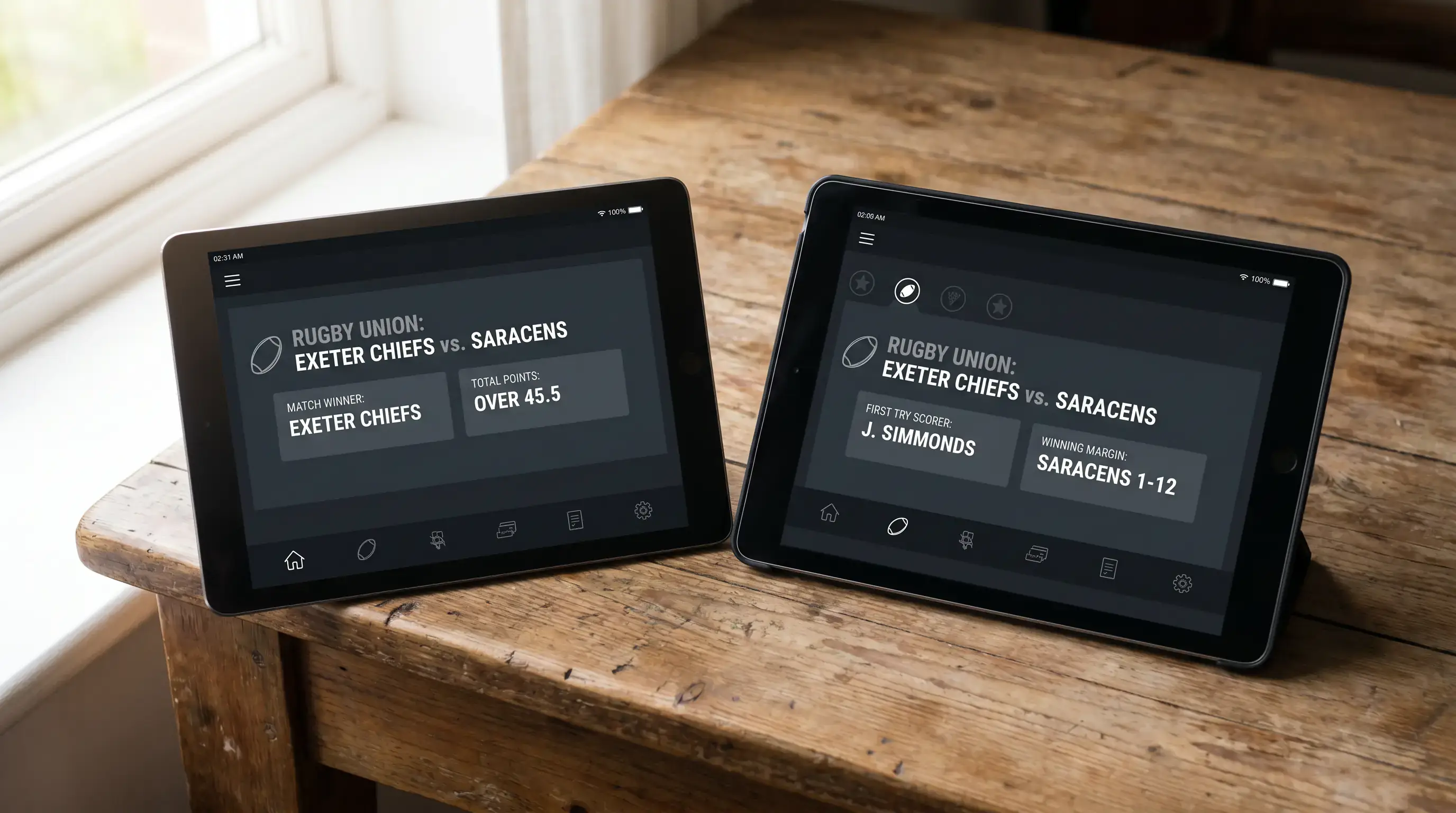
Three combinations dominate UK rugby bet builder volume. The first is match result plus try-scorer — backing one team to win and a named player from that team to score at any point. The play is intuitive: if you’ve built a strong view that England wins, the most likely supporting fact is that a named England back also crosses the line. Combined prices typically land in the 4/1 to 10/1 range depending on the matchup and the named player.
The second is total points plus handicap — pairing an over/under view with a margin view on the same match. This is the most-staked combination during Premiership weekends, because the two markets together capture the dominant pre-match read most punters form. England by 12-plus and the total over 44.5 is the classic combined play for a heavy-favourite matchup, with prices in the 5/2 to 9/2 region depending on how aggressive the line and the total are.

The third is first try scorer plus total points — combining a specific player to open the scoring with a total points view. The first try scorer leg is the longest-priced limb in any rugby market, and combining it with a low-margin total view produces a price that can sit beyond 15/1 even on a strong-favourite match. The play is the high-variance one, and it’s worth understanding the underlying market dynamics first by reading the first try scorer market mechanics. The combined bet builder is only as good as the individual selection that anchors it.
How Many Legs Can You Actually Stack
The standard UK ceiling on rugby bet builders sits at twelve legs across most major operators. A handful go higher — up to fifteen or even twenty on internal builder products — but the practical limit on rugby is around six to eight legs before the price collapses to almost nothing and the variance becomes lottery-tier. Six legs is the upper end of where I see anyone staking professionally.

The markets allowed in a single builder are restricted to those the operator’s correlation engine can handle reliably. Match result, handicap, totals, half totals, try scorer (first, anytime, last), winning margin, card markets, drop goal markets and bet builder-specific player props are all typically available. Some niche markets — exact scoreline, certain niche player markets, some live-only markets — are blocked from builders entirely. The reason is computational: the engine can’t reliably price the correlation between markets it has insufficient joint data on, so it removes them from the build menu rather than mispricing them.
What the Correlation Adjustment Actually Costs You
The honest way to think about bet builder pricing is that the engine takes a slice of expected value at every correlated leg. The slice is variable — it can shave 5 per cent off a weakly correlated build, 20 per cent off a heavily correlated one. The average shave on a typical three-leg builder sits around 10 to 15 per cent below the multiplied price. That’s the cost of asking for a custom market rather than taking the bookmaker’s pre-existing products.
Whether the shave is worth it depends entirely on whether you have a layered view that’s better than the bookmaker’s. If your read on the match is “favourite wins, total goes over, named back scores,” and you’ve built that view from solid pre-match analysis, the combined bet builder is one of the most efficient ways to express it. If your read is fuzzier — “I think England plays well” — the bet builder is a way of paying the bookmaker for fuzz. The product rewards specificity and punishes vagueness. With the UK’s 13.5 million active monthly online accounts producing huge volumes of bet builder turnover, the engines have a lot of data to fit to, and a generic builder built without specific reasoning will be priced against you accurately.
Cashing Out a Bet Builder Mid-Match
Bet builders interact with cash-out differently from singles or accas. Cash-out values on bet builders update with every match event that affects any leg of the build. A four-leg builder with three legs already settled and one still live can be cashed out at almost the full multiplied price minus the operator’s margin on the remaining leg. A four-leg builder with two legs settled and two still live carries a more complex cash-out value, because the operator has to price the joint probability of the remaining outcomes.

Partial cash-out — the option to lock in a portion of the current value while leaving the rest exposed — works on bet builders at most major UK operators, but the partial slice is usually capped at a percentage of the current cash-out value rather than a free-form choice. Some operators don’t offer partial at all on builds with three or more remaining live legs, because the engine can’t reliably price the residual position. Read the cash-out rules on your specific operator before staking a builder you might want to exit early. The flexibility you assumed exists may not, and in-play betting accounts for more than 70 per cent of UK online sports betting volume — meaning a lot of cash-out activity happens during live windows where the builder rules can be the most restrictive.
